17.07.2026
221
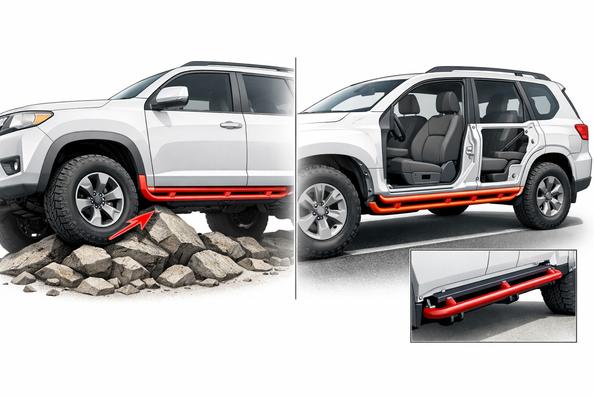
Rock sliders protect the body not by themselves, but only when they are truly load-bearing конструкция that mounts to the frame or reinforced body points and can take the vehicle’s weight. If what’s sold as “heavy-duty” is actually обычні side steps or thin бокові tubes, they чаще help only when getting in, and on an obstacle can steal ground clearance, bend, and transfer the удар into the rocker.
That’s why the very same purchase becomes real protection for one driver, and for another — an extra 35.8–90.7 kg per pair and added risk in ruts, on rocks, or on a high curb. The key question here is not the product name, but the design, mounting, and your real driving scenario.
The confusion starts with naming. On the market you’ll see rock sliders, side steps, protective steps, and hybrid solutions side by side, but visually they’re often similar. A person sees a chunky tube, assumes it protects the body, and then finds out the product isn’t rated for the vehicle’s weight and isn’t meant to be used as a jacking point.
The second reason is different operating conditions. For the city, highway, and light dirt roads, a side step really can be enough. But if the vehicle regularly hits rocks, logs, deep ruts, or sharp terrain breaks, you need not a convenience accessory, but a structural element that slides over the obstacle instead of the body.
DD Tuning expert comment: the most common mistake is buying heavy sliders “just in case,” even though the vehicle only sees the city and parking lots. The second typical mistake is focusing on a thick tube rather than the mounting scheme. When selecting, we always look not only at appearance, but at whether the client needs a jacking point, whether easy entry matters, and whether the vehicle will actually contact obstacles on the side.
| Symptom | Likely cause | What to do |
|---|---|---|
| After light contact, not only the rocker but also the body was damaged | A side step or weak design without reinforced points is installed | Replace with a true rock slider or remove the decorative kit if protection isn’t needed |
| The vehicle more often catches curbs and terrain breaks with the side | Sliders are installed too low and reduce geometric clearance | Check how the kit sits, compare the lowest point with the stock body line; sometimes it’s more logical to отказаться of heavy sliders |
| There’s squeaking, play, or knocking underneath | Loose mounts or deformed brackets | Inspect the installation, tighten fasteners per the instructions, replace damaged elements |
| There are chips and rusty spots on the tube | The coating is damaged by salt, sand, or impacts | Wash, clean up, touch up chips, and inspect regularly after the грязь season |
| Entry is comfortable, but there’s no real protection on trips | Standard side steps were chosen instead of a load-bearing construction | Define the task honestly: either keep the step for comfort or switch to a heavy-duty kit for protection |
Only the solution that matches the route works. If the vehicle drives on rocks, forest ruts, sharp exits from holes, or often sits sideways on an obstacle, you need a rock slider that takes the load itself, not a decoration along the body.
The second thing is correct mounting. A good kit doesn’t just hang on the side — it distributes the impact into reinforced points. That kind of construction can protect the lower edge of the doors and the rocker itself, and in some cases also serve as a working jacking point.
The third is a healthy balance. If the vehicle is tall but the family gets in daily, sometimes a hybrid solution makes sense: a minimally protruding step with a truly load-bearing base. And maintenance is mandatory: wash off salt and sand, inspect mounts, and quickly touch up chips.
Relying on the name without checking the design doesn’t work. If the description is full of words about comfortable entry but there’s no clear information about reinforced points and taking the vehicle’s weight, it’s not the kind of protection that saves the body on an obstacle.
The idea “I’ll install any tube, just so there’s something” also hardly helps. Low-hanging elements can reduce clearance and snag where the stock body would still pass. Likewise, simply tightening the sliders won’t help for long if the bracket has already been bent after an impact.
Another false economy is not treating chips. On rock sliders the coating takes abrasive нагрузка, so without quick touch-up and washing, corrosion starts exactly from small поврежження.
If the goal is only to make it easier to get into a tall vehicle, it’s more logical to look at side steps rather than hauling extra weight for looks. But if the body really contacts ruts, rocks, or curbs, then rock sliders with load-bearing mounting make sense. And if you haven’t decided between comfort and protection yet, it’s useful to first understand the difference via the material about the pros and cons of rock sliders.
Replacement is also needed when the vehicle already has thin side steps that bent after the very first contact. In that case, it’s cheaper to switch once to a design that matches the real scenario than to repair the body and install another weak kit again.
| Solution | When it works | When it’s not worth spending money |
|---|---|---|
| True rock sliders | When the vehicle regularly drives where it can sit the rocker onto a rock, log, curb, or the edge of a rut | When the vehicle is almost always in the city and there are no contacts with obstacles |
| Hybrid slider-step | When you need both easier entry and basic protection from side contact | When harsh routes are planned where full load-bearing strength is needed with no compromises |
| Standard side steps | When the priority is entry comfort, cleaner pants, and protection from minor road грязь | When you expect them to hold the vehicle’s weight or protect on rocks |
| Removing a heavy kit | When the sliders only reduce clearance and don’t solve any real task | When without them the body already regularly suffers from contact with obstacles |
| Coating repair and mounting inspection | When the design itself is correct but needs service after a season | When the problem isn’t the paint but a weak mounting scheme or an already deformed product |
From a customer’s experience: often a person first looks for just a step for a tall crossover or pickup, and after the first trips sees scuffs precisely in the rocker area. In this scenario, the greatest satisfaction comes not from a “massive look,” but from the right switch to a load-bearing construction that takes the hit itself and doesn’t force you to straighten the body later. If the vehicle remains a city car, customers are usually happy with simpler steps because they don’t overpay for something they don’t use.
Rock sliders make sense only where there is a real risk of side contact with an obstacle and a load-bearing construction is needed, not just a convenient step. The main selection criteria are simple: where the product mounts, whether it supports the vehicle’s weight, how much it hangs down, and whether it matches your route.
If that’s not the case, sliders really can turn into just extra weight, less ground clearance, and additional costs. This material is based on real selection experience, practice, and real usage scenarios, so the conclusion is one: buy not a “heavy-duty look,” but a construction for a specific task.
| ✔ | Power side steps really protect the body only when they mount to the frame or load-bearing points and can take the weight of the vehicle. In this setup, they absorb the impact themselves instead of passing it into the sill or body. |
| ✔ | Off-road, they are useful where the vehicle regularly hits rocks, logs, curbs, or the edge of a track. This reduces the risk of damaging the lower edge of the doors and the sill itself. |
| ✔ | With proper installation, a power side step can serve as a jacking point. This is practical when you need to lift the vehicle in the field. |
| ✔ | Hybrid solutions offer a compromise between access and protection. For taller vehicles used daily by a family, this can be more convenient than a purely power, heavy-duty kit. |
| ✔ | If the design is right but the coating has been damaged by salt or sand, it can be restored without replacing the whole unit. Regular inspection and touch-up painting extend the life of the set. |
| ✘ | If ordinary side steps or thin tubes are sold under the name of “power” ones, they do not fully protect the body. Hitting an obstacle can bend such a design and also transfer the удар into the sill. |
| ✘ | Heavy kits add a lot of mass — the article mentions values of 35.8–90.7 kg per pair. For a city car, this may be just unnecessary ballast with no benefit. |
| ✘ | Low-mounted sills reduce ground clearance and catch curbs or breaks in the terrain first. As a result, they do not improve and sometimes even worsen off-road capability. |
| ✘ | If the mounting is weak or the brackets are deformed, the structure will not withstand a side impact. Then even a massive look does not save it from play, squeaks, and body damage. |
Shipping to EU
Wholesale and retail
Own warehouse
Опис продукту
Подарунки не надаються при оформленні покупки у кредит під 0,01% або при покупці частинами.