22.07.2026
227
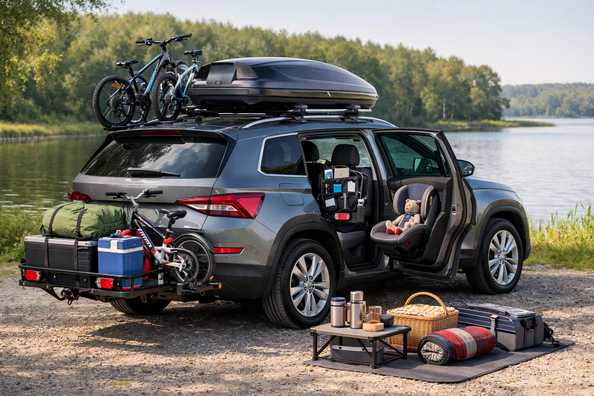
This upgrade package is for a Skoda Kodiaq 2016-2023 owner who carries kids, a stroller, groceries, suitcases and wants to make the car more convenient for real family use, not for looks. The main goal here is not to cover the car in accessories, but to make sure luggage and small items don’t roll around the cabin, the trim doesn’t get worn out every day, and extra volume appears only when it’s truly needed.
On the Kodiaq, the difference between use cases is big: in the 5-seat version the trunk is very spacious by itself, while in the 7-seat version with the third row up there isn’t much room left. That’s why the logic of the upgrades is simple: protection and organization first, then family comfort, and only after that the expensive roof or bike solutions.
For a family Kodiaq, the right upgrade should cover three tasks. The first is to protect the trunk and cabin from dirt, moisture, kids’ items, stroller wheels, shoes, and bags. The second is to secure small items so they don’t fly around the trunk on every turn. The third is to add volume only when the stock space is no longer enough for a specific trip.
On this model, a lot depends on the configuration: 5 or 7 seats, a standard floor or a false floor, the presence of roof rails, and for some solutions a towbar as well. So there’s no one universal kit for every Kodiaq: what’s convenient on a 5-seater may be pointless or incompatible on a 7-seater.
Step one is trunk protection. If you carry wet, dirty, or heavy items, it’s more practical to look at a rigid plastic tray. If your cargo changes constantly, the backrests are folded often, and you also need to cover the side panels, a foldable trunk protector works better. For the 5-seat version with a standard floor, a reversible trunk mat also makes sense: one side for clean items, the other for dirty ones.
Step two is securing small items. Nets, hooks, organizing compartments, and separating items bring more day-to-day value than buying a roof box right away. It’s important not to overestimate a net: it’s good for light items, but it doesn’t replace a tray or a rigid organizer.
Step three is protecting the cabin from the “kids” scenario: floor mats, a child-seat underlay, and elements that take the brunt of shoe marks and minor dirt. It’s not the flashiest purchase, but it’s the one that delivers a noticeable result every day.
| Upgrade | Why it’s needed | Who it really benefits |
|---|---|---|
| Plastic trunk tray | Contains moisture, sand, dirt and prevents small cargo from sliding on the floor | Families with a stroller, sports gear, groceries, trips to the cottage; especially useful for those who often clean the trunk |
| Foldable trunk protector | Covers not only the floor but also part of the sides; convenient when changing seat configurations | Those who carry kids’ items, pets, large bags, or often fold the rear backrests |
| Reversible trunk mat | Lets you separate “clean” and “dirty” use without constant cleaning | Mainly for 5-seat cars with a standard floor where a tall rigid lip isn’t needed |
| Trunk net | Secures light items: first-aid kit, small bags, care products, toys | Those with a 5-seat car with a false floor who need to tame small clutter; not for heavy cargo |
| Rear-cabin sun shades | Reduce heat buildup, add shade, and hide trunk contents from prying eyes | Families with kids, those who often drive in summer or leave items in the trunk during stops |
| Crossbars and a roof solution | Add extra volume when the stock trunk is genuinely not enough | 7-seat Kodiaq on long trips, skiers, families with lots of seasonal equipment |
| Towbar-mounted bike rack | Transports bikes without lifting them onto the roof and without extra load on the top of the car | Those who regularly carry bikes and already have a towbar with the permitted load |
DD Tuning expert comment: The most common mistake on a Kodiaq is buying an expensive roof system before solving the basic issues of dirt control and securing items inside. The second typical problem is not checking whether you have 5 or 7 seats and what type of trunk floor you have. Because of this, people buy an accessory that’s formally “for Kodiaq”, but in their specific car it’s either inconvenient or doesn’t fit properly.
Once the trunk is protected and things aren’t flying around, the second stage is about adding what reduces day-to-day fatigue. For a family, that’s primarily rear-cabin sun shades, protection for the second row from kids’ feet, and protection for the loading lip if a stroller or heavy bags are often placed in the trunk.
If you regularly go on vacation with a full crew, this is the stage where it makes sense to think about a roof solution or a towbar bike rack. But only after an honest check of your use case: in a 5-seat Kodiaq the stock volume is often enough, while in a 7-seater the roof becomes truly necessary when the third row is used all the time.
For long trips with an overnight stay or roadside breaks, a separate but niche add-on can be leveling panels. This isn’t a basic purchase and it depends on the floor configuration, so for most families it’s a third-tier upgrade rather than a starting point.
In a family scenario, I’d put sun shades, trunk-sill protection, proper cabin floor mats, and, if needed, a power tailgate among the comfort-focused upgrades rather than purely decorative ones. These don’t add liters, but they reduce the number of small everyday annoyances.
More about appearance are chrome trim pieces, some decorative moldings, and certain styling overlays on the body. For the “family plus luggage” scenario, they don’t solve any core task. If the budget is limited, it’s best to leave them for last—after protection and organization.
A separate gray area between utility and visuals is a rear bumper protector. If you really load and unload the trunk often, it’s protection. If the trunk is opened once a week for grocery bags, there’s no pressing need.
Most often, people buy a roof box “just in case” for no reason. If the car spends most of its time in the city in a 5-seat configuration, and big trips happen a few times a year, an expensive set easily turns into something that sits in the garage more than it works.
The second mistake is hoping one net will solve everything. On a Kodiaq it’s only useful for light small items, and not in every configuration. It won’t replace a solution for heavy bags, canisters, kids’ ride-on gear, or wet equipment.
The third mistake is buying an accessory that doesn’t match your version of the car. For the Kodiaq, this is critical: 5 or 7 seats, a standard floor or a false floor, the presence of roof rails. This is where people most often overpay—choosing something nice-looking or popular instead of something compatible and useful.
| Scenario | What to install first | What can be postponed | What’s optional |
|---|---|---|---|
| 5-seat Kodiaq for city and family | Trunk protection, cabin floor mats, securing small items | Sun shades, trunk-lip protection | Roof box, decorative trim |
| 7-seat Kodiaq, third row used from time to time | Tray or protection for your specific configuration, order in the trunk, seat protection | Crossbars until the first big trip | Chrome package, duplicate organizer add-ons |
| 7-seat Kodiaq, frequent long trips fully loaded | Trunk protection, sun shades, control of configuration and accessory compatibility | A roof solution or a bike rack until the stock volume is genuinely not enough | Any tuning that doesn’t add space or protection |
| Family with bikes or seasonal equipment | Decide what’s more rational: roof or towbar; only then choose the rack | Power tailgate if it’s not needed daily | A second way to carry the same equipment “just in case” |
Expensive solutions are justified when they work not once a season, but for your ongoing use case. If you have a 7-seat Kodiaq and the third row is often occupied on trips, then a roof rack for rails becomes not a whim but the foundation for expanding capacity. An important point: there is a roof load limit, and the crossbars and box themselves also consume part of that allowance.
If you haven’t decided on the format yet, it’s worth first looking at all roof systems for Kodiaq and only then deciding whether you need a box or another solution is enough. For bikes, for example, it’s often more rational to look toward the towbar right away, if you have one and it allows the required load.
Another example of a pricier but noticeably useful everyday add-on is a power tailgate. For a family that often approaches the car with hands full, it can sometimes be more useful than exterior decor, even though it doesn’t increase capacity.
From a customer’s experience: the owner of a 7-seat Kodiaq initially wanted to install a roof box right away, because with the third row up there was almost no space left for kids’ items. After selection, it turned out that what bothered him daily was the clutter in the small trunk compartment, so he first installed protection, organization, and sun shades, and bought the roof system only before vacation. As a result, the expensive upgrade started doing its job instead of sitting idle.
For a Skoda Kodiaq 2016-2023, a family-and-cargo package should be built not from the most expensive item, but from the most frequent use case. First protect the trunk and cabin, then secure small items and add comfort for the family, and then move to roof or towbar solutions if the stock volume is truly too small. This sequence cuts out marketing clutter and prevents overpaying for looks instead of usefulness.
The material is based on real selection experience, practice, and real usage scenarios: what actually works every day, what only makes sense for long trips, and what can be safely postponed or not bought at all.
| ✔ | It first covers basic family needs: protecting the trunk and cabin from dirt, moisture, strollers, shoes, and children’s items. This is useful in everyday use, not just on occasional trips. |
| ✔ | It provides a clear upgrade path without unnecessary spending: protection, securing small items, comfort for the family, and only then roof solutions or bike mounts. This approach helps avoid buying expensive but unnecessary equipment too early. |
| ✔ | The text is tied to specific Kodiaq configurations — 5 or 7 seats, standard floor or false floor, roof rails, tow bar. This makes it easier to choose for your car and reduces the risk of buying something incompatible. |
| ✔ | It clearly separates what really works for light items and what does not: the net is suitable for small things, while a tray or foldable protection is for heavier and dirty cargo. This helps choose a practical option rather than a universal one. |
| ✔ | There is a separate emphasis on family comfort: sunshades, mats, child seat protection, trunk sill protection. Such small details do not add volume, but noticeably reduce everyday inconvenience. |
| ✘ | For the 7-seat version with the third row raised, trunk space becomes limited, and without additional solutions there may not be enough room. That is, the basic package may be insufficient for large family trips. |
| ✘ | The trunk net has a narrow use case: it is useful only for light small items and does not replace a tray or rigid organization. If you rely on it as the main means of securing cargo, the result will be weak. |
| ✘ | Some useful solutions depend on the specific vehicle configuration, so it is easy to make a wrong purchase. The text directly says that an accessory “for Kodiaq” may turn out to be inconvenient or incompatible if the configuration is not taken into account. |
| ✘ | More expensive options like a roof box or bike mount may turn out to be unnecessary if the car mostly drives in the city and there are few long trips. Then they just take up space and provide no daily benefit. |
Shipping to EU
Wholesale and retail
Own warehouse
Опис продукту
Подарунки не надаються при оформленні покупки у кредит під 0,01% або при покупці частинами.