28.07.2026
184
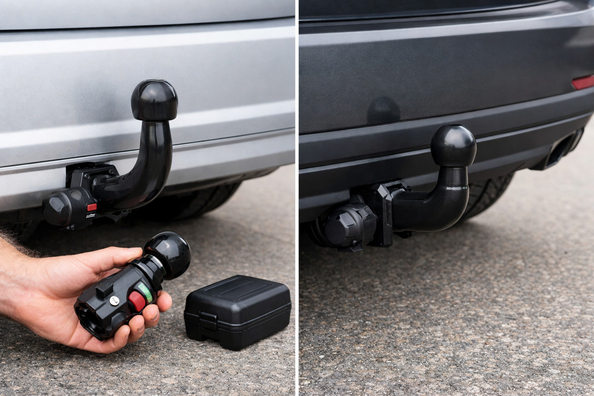
For daily driving, a detachable towbar usually wins if you need a trailer or platform a few times a year, and the rest of the time what matters is normal parking, a clean rear bumper, and no part sticking out. A fixed towbar is more logical when it’s in constant use: a cottage run, a boat, a work trailer, regular trips with a load.
The key point is simple: a quality detachable towbar isn’t weaker just because it detaches. The real choice here isn’t about strength, but about your usage pattern, maintenance, convenience in the city, and whether you’re willing to live with a towbar that’s always at the back—or one that requires a few steps before you set off.
A fixed towbar is a tool that’s always ready. It’s cheaper, simpler in daily use, and requires almost no attention after installation. For those who tow often, it’s the most straightforward scenario: pull up, hook up, and go.
A detachable towbar is a compromise in favor of everyday comfort. When you don’t need the ball, you can remove it, and the rear of the car interferes less with parking, access to the trunk, and the operation of rear sensors. That’s why for a car that spends most of its time without a trailer, a detachable option is often more practical.
The nuance is that the choice doesn’t come down to just two words on the price tag. Within both types there are subtypes: among fixed towbars—standard and flange-mounted; among detachable—different locking systems. If heavier work or specific accessories are planned, you need to look not only at the type, but also at the exact vehicle-specific design.
| Option | Strengths | Weaknesses | Who it suits |
|---|---|---|---|
| Fixed | Always ready to work, lower price, minimal maintenance, a good choice for frequent towing | Always visible, can interfere with parking sensors and access around the trunk, doesn’t allow a “clean” rear end | Those who regularly drive with a trailer, use the car for work, or don’t want to install the ball every time |
| Detachable | After removal it’s almost invisible, more convenient for the city, fewer everyday annoyances, not inferior in strength to a quality fixed towbar | More expensive, requires care of the mechanism and checking the lock, you need to store the keys and the ball itself | Those who tow rarely but use the car in the city every day and don’t want to constantly see a towbar at the back |
DD Tuning expert comment: The most common mistake is buying a fixed towbar only because it’s cheaper, even though the trailer comes out two or three times a season. The second typical story is choosing a detachable one and not maintaining the mechanism in winter, which makes the fit tight or causes locking issues. If the car is mainly used in the city and towing is occasional, it’s worth honestly assessing the everyday scenario—not just the purchase budget.
Its main advantage is predictability. There’s no separate ball, keys, lock, or installation procedure before a trip. For frequent trailer runs, this is convenient: fewer steps, fewer chances to forget something at home.
In terms of durability, it’s the simplest and most trouble-free option. If the design is correctly matched to the vehicle, a fixed towbar can serve for the entire life of the car with minimal maintenance. For commercial tasks and heavier loads, people often look in this direction—especially to flange-mounted systems—but here the vehicle-specific ratings and approvals are critical.
The downsides are also obvious: the ball always sticks out, can interfere with parking sensors, and in everyday use you regularly notice it’s there. On some cars, fixed solutions are also structurally limited if they cover the license plate or rear lights.
Its strong side is flexibility. When the towbar isn’t needed, the rear of the car remains almost stock-looking. For daily city use, this is genuinely noticeable: fewer chances to bump into the ball, easier parking, fewer unnecessary triggers from rear sensors.
In terms of load, a quality detachable towbar isn’t a “lighter-duty” solution just because of the mounting principle. But you pay for this convenience not only with money. The mechanism must be kept clean, the lock cared for, the keys not forgotten, and the fixation checked before you set off. A normal routine here looks like this: the ball is seated with no play, the marks align, the handle is fully engaged, the lock is closed, and the key is removed.
There are also everyday limitations. You don’t remove a detachable ball under load—meaning when a trailer or bike rack is already attached. After winter salt and aggressive washing, the mechanism requires more careful servicing; otherwise problems start exactly there, which people mistakenly blame on the type being “unreliable.”
If the car drives in the city every day and you need a trailer a few times a year, the detachable option has the edge. In this scenario, most of the time you’re using the car without a towbar, and that should be the basis of the choice.
If a trailer, boat, car hauler, or work load is a regular part of life, a fixed towbar is more practical. It requires no additional actions before setting off and fits better into a routine where constant readiness matters.
For more demanding tasks—for example, heavier trailers or specific attachments—you don’t look only at the words “fixed” or “detachable,” but at the subtype of design and the manufacturer’s ratings/approvals. If you plan both a trailer and separate towbar-mounted equipment, selection must be especially careful.
| Scenario | What’s better to choose | Why |
|---|---|---|
| City car, trailer 2–5 times a year | Detachable | In daily driving, looks, parking, and the absence of a protruding ball matter more than constant readiness |
| Cottage, boat, trailer almost weekly | Fixed | Fewer steps before departure, lower price, and simpler life with regular use |
| Work vehicle or commercial load | Fixed, often flange-mounted | The focus is on constant readiness, simplicity, and suitability for heavier tasks if the vehicle has the required ratings/approvals |
| Car with sensitive parking sensors, tight parking | Detachable | After removal, the ball doesn’t get in the way in everyday use |
| The driver dislikes maintenance and doesn’t want to check anything before trips | Fixed | It has almost no daily routine related to fixation and the lock |
| The car is used mostly without a trailer, but you want to keep a neat look | Detachable | You pay more once, but you don’t live with a protruding part at the back all the time |
A more expensive detachable towbar makes sense when the car lives in the city every day and towing is occasional. In that case, you’re not paying for “premium,” but for the fact that 95% of the time you’re not carrying an extra protruding part. To start, it’s worth looking at the towbars themselves and immediately filtering out designs that don’t fit your usage pattern.
Another scenario for a more expensive solution is when you need the towbar not only for a trailer, but also for a bike rack. Here it’s important not to miss with the design type and usage method, so it’s useful to read separately about a towbar for a bike rack.
If the main concern is the complexity of servicing a detachable coupling, then a more expensive solution is justified only if you’re ready to use it properly. Before buying, it’s worth understanding what real coupling issues look like and what to check in operation: this play check clearly shows where people make mistakes even before replacement.
From a customer’s experience: the owner of a crossover was looking for a cheaper fixed option because they towed a trailer a few times during the summer. After a conversation, it turned out the car parks daily in a tight underground garage and drives around the city all the time, so they chose a detachable towbar. As a result, the person doesn’t overpay with daily inconvenience and installs the ball only when it’s truly needed.
For daily driving, a detachable towbar is more logical in most cases: it’s not worse in strength, but it interferes less in the city, in parking, and in everyday use of the trunk. A fixed towbar wins where a trailer isn’t an exception but a normal part of the route, and where simplicity matters more than looks and comfort without a load.
The best choice here isn’t abstract, but scenario-based: how often you tow, whether you’re willing to maintain the mechanism, and whether sensors and a clean rear end matter. This material is based on real selection experience, hands-on practice, and real-life usage scenarios—so the main advice is simple: choose not the “best type overall,” but the one that will annoy you least in your daily use.
| ✔ | A detachable tow bar is more expensive and requires regular care: the mechanism needs to be cleaned, lubricated, and checked for proper locking, especially in winter. |
| ✔ | Before driving with a detachable tow bar, you need to check the installation every time, and the ball itself must not be removed under load. |
| ✔ | A fixed tow bar always sticks out at the rear, so it can get in the way when loading the trunk, catch your foot, and create inconvenience in tight parking spaces. |
| ✔ | On some cars, a fixed solution may interfere with parking sensors or even block the license plate or rear lights. |
| ✔ | A detachable tow bar is less of a nuisance in everyday city driving: after removal, it does not affect parking, does not get in the way near the trunk, and is less likely to trigger parking sensors. |
| ✔ | A high-quality detachable tow bar is no less strong than a fixed one, so if towing is infrequent, you can get convenience without losing working capability. |
| ✔ | A fixed tow bar is convenient for regular use because it is always ready to work and does not require any extra steps before each trip. |
| ✔ | A fixed solution is usually cheaper and requires almost no maintenance after installation, which makes life easier for those who often tow a trailer. |
| ✔ | For a car that mostly drives without a trailer, the detachable option better preserves the neat look of the rear end. |
| ✘ | A detachable tow bar is more expensive and requires regular care: the mechanism needs to be cleaned, lubricated, and checked for proper locking, especially in winter. |
| ✘ | Before driving with a detachable tow bar, you need to check the installation every time, and the ball itself must not be removed under load. |
| ✘ | A fixed tow bar always sticks out at the rear, so it can get in the way when loading the trunk, catch your foot, and create inconvenience in tight parking spaces. |
| ✘ | On some cars, a fixed solution may interfere with parking sensors or even block the license plate or rear lights. |
Shipping to EU
Wholesale and retail
Own warehouse
Опис продукту
Подарунки не надаються при оформленні покупки у кредит під 0,01% або при покупці частинами.