08.06.2026
274
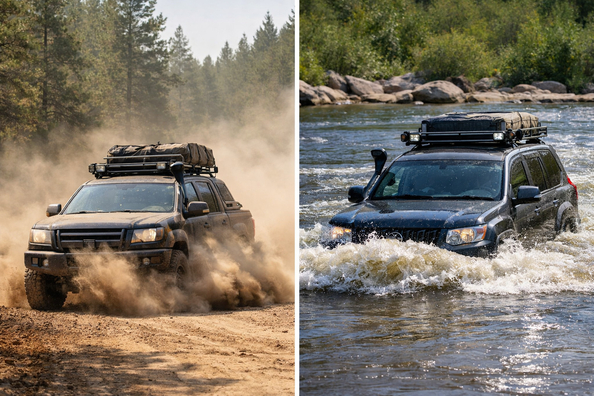

In short, a snorkel delivers the biggest real benefit not on a one-off water crossing, but in constant dust: on dirt roads, in a convoy, at a quarry, in fields, and on forest roads. That’s where a raised air intake and a properly chosen head reduce the amount of dirt that reaches the main filter, improving service life and making maintenance more consistent.
A snorkel is also useful for water, but it doesn’t work on its own. If breathers, joint sealing, connectors, and the vehicle’s real wading capability aren’t addressed, a single tube on the A-pillar won’t turn your car into an amphibious vehicle. So the choice is simple: for dust it’s often a practical tool; for wading it’s only part of a system.
In reality, you’re not choosing between “dust” and “water” so much as between different tasks. If the vehicle spends most of its time on dry roads behind other cars, the logic is one thing: raise the air intake point higher and, if possible, cut off coarse dust before the factory filter. If the main scenario is driving through water, the logic is different: minimize the risk of ingesting water into the intake, while remembering that vulnerable components may still sit lower down.
That’s why the question isn’t “do you need a snorkel at all,” but whether it will pay off in your specific use. For city driving and clean highways, the benefit is often weak. For dust, it’s noticeable. For serious wading, it only makes sense together with other upgrades.
One more important point: efficiency numbers for dust pre-filters from different manufacturers shouldn’t be read as if they’re on one shared scale. Designs, test methods, and the nature of contamination differ, so focus not on a pretty percentage but on your own scenario.
| Option | Strengths | Weaknesses | Who it’s for |
|---|---|---|---|
| Basic snorkel with a standard head | Raised air intake, basic protection from splashes, rain, snow, and debris thrown up by the wheel | Limited gains in heavy dust; for wading it doesn’t solve everything on its own | For those who drive mixed use: a bit of off-road, a bit of water, without extreme conditions |
| Snorkel with a cyclone or pre-filter head | Best real-world effect in dust, less load on the main filter, less frequent servicing | More expensive; sometimes more maintenance and seasonal nuances | For those who often drive in convoys, at quarries, in fields, and on forest and construction roads |
| Snorkel as part of a full wading build | Reduces the risk of water entering the intake; a logical element of expedition prep | The most expensive scenario, because it requires not only a tube but comprehensive vehicle sealing | For those who truly wade regularly and understand the limits of their specific vehicle |
DD Tuning expert comment: Often a customer says they’re buying a snorkel “for water,” but after a few clarifying questions it turns out the main mileage is on dry dirt roads behind other vehicles. In that case, the biggest point isn’t just a tube, but the right top head and a sealed installation with no air leaks. Another common mistake is looking for a universal solution based on appearance rather than a kit for a specific model and the actual tract diameter.
This is the most straightforward format: you raise the air intake above the zone where, under the hood, there’s more water mist, snow, and wheel-thrown dust. For everyday off-road use, that’s often enough to get benefits without a complicated setup.
The weak point is that in heavy dust the basic head doesn’t always deliver the effect people expect. Yes, the air is taken from higher up and is cleaner, but coarse dust isn’t separated as effectively as with cyclone heads or dedicated pre-filter solutions.
This is the strongest option specifically for dust. The idea is to divert part of the contamination before it reaches the main filter. In a convoy, on dry dirt roads, and in quarry and agricultural conditions, the difference is most noticeable: the filter lasts longer and maintenance becomes more predictable.
But requirements for compatibility and practicality increase. Not every top section is equally suitable for daily use in a wet winter, and some foam solutions are more about the dusty season than year-round operation.
For wading, a snorkel is needed, but it isn’t the main hero. If the vehicle has vulnerable components mounted low, breathers aren’t extended, or critical joints aren’t sealed, the real limit is defined not by the intake height, but by the whole vehicle.
That’s why the most expensive water-focused setups only make sense where water is not an occasional episode but a regular scenario. Otherwise it often turns out that a person pays for the image of a “built” off-roader and uses only a few percent of its potential.
If you have a pickup, SUV, or commercial vehicle that constantly swallows dust behind machinery, a snorkel with a dust head will deliver the most noticeable result. The gain here isn’t theoretical: less dirt at the inlet, fewer filter checks, and fewer chances of choking the engine with a clogged element in season.
If you go fishing, hunting, or into the mountains and encounter water periodically, a basic model-specific snorkel is often smarter than a complex dust setup. In this mode, assembling the tract properly matters more than chasing maximum dust separation.
If the vehicle hardly ever leaves asphalt and a snorkel is considered “just in case,” the benefit is usually weak. In that scenario it’s a low-ROI accessory, especially once you add installation costs.
| Scenario | Best choice | Why |
|---|---|---|
| Weekly convoy trips on dirt roads | Snorkel with a cyclone or pre-filter head | This is where filter life and stable operation in heavy dust improve the most |
| Quarry, construction site, field, forest | Quality model-specific kit with a dust-focused top | In working conditions, it’s not the look that pays off but less intake contamination and less downtime for service |
| Trips with occasional water crossings | Basic snorkel with sealed installation | Gives a raised air intake without unnecessary complexity and covers most non-extreme water scenarios |
| Regular deep water crossings | Snorkel plus comprehensive wading preparation | A single tube doesn’t address breathers, joints, electrics, or the vehicle’s true wading capability |
| City and clean highway | Often better not to install or not to overpay | The real benefit is minimal, while the kit and installation costs remain |
Paying extra makes sense in three cases: when the vehicle works in dust all the time, when you need a kit precisely for your model without compromise installation, and when water is not an exception but a regular part of your route. In these scenarios, the higher price is justified not by an “off-road look,” but by lower risk of mistakes, better compatibility, and a more predictable result.
If the vehicle lives in the city and off-road trips are rare, it’s better to assess the task soberly before buying. To do that, check the snorkel catalog, review the basics in how to choose a snorkel, and for a final reality check read the short explanation what a snorkel does.
From a customer’s experience: A pickup owner was looking for a solution “for wading,” but after analyzing the route it turned out the truck more often drives on dry field roads and in dust behind machinery. In the end, he chose a model-specific snorkel with a cyclone head instead of a simple water-focused configuration, and valued most not getting through puddles, but the fact that the air filter stayed noticeably clean for much longer. For his use, it turned out to be smarter than investing in deeper water preparation that he would hardly ever use.
If you want an honest answer, a snorkel most often wins in dust rather than in water. For dusty roads, convoys, and working vehicles, the best scenario is a model-specific kit with the right dust head. For wading, a snorkel is also useful, but only together with sealing and an understanding of the real wading capability of your specific vehicle. For the city and clean highways, the extra cost often doesn’t pay off. This conclusion is based not on catalog theory, but on real selection experience, hands-on practice, and real-world use cases.
| ✔ | In dusty conditions, a snorkel really reduces the amount of dirt reaching the main filter. This is especially noticeable on dirt roads, in convoys, at quarries, in fields, and on forest roads. |
| ✔ | A snorkel with a cyclone or pre-filter head delivers the best practical effect specifically in dust. It takes the load off the main filter, so it needs to be checked and serviced less often. |
| ✔ | For occasional water crossings, a basic snorkel provides a raised air intake and reduces the risk of drawing in splashes and water mist. This is useful without complicated vehicle preparation. |
| ✔ | In work scenarios, a snorkel can make operation more predictable. Less intake contamination means fewer chances of problems from a clogged filter during the season. |
| ✔ | For vehicles that regularly drive in dust, a snorkel can be economically justified. The biggest benefit here is not the appearance, but the real filter life and stable operation. |
| ✘ | For serious wading, one pipe on the pillar does not eliminate all risks. You still need breathers, sealed joints, attention to connectors, and an understanding of the vehicle’s actual wading capability. |
| ✘ | In the city and on clean highways, the benefit of a snorkel is often weak. In this mode, the cost of the kit and installation may not pay off. |
| ✘ | Dust heads and other top-mounted solutions are not always convenient in wet winter conditions, snow, or salt. Some of them add seasonal nuances and require configuration changes. |
| ✘ | Installation may not be as simple as it seems. If the intake tract is not sealed and the diameters are not correct, there is a risk of air or water ingress. |
Shipping to EU
Wholesale and retail
Own warehouse
Опис продукту
Подарунки не надаються при оформленні покупки у кредит під 0,01% або при покупці частинами.