28.07.2026
219
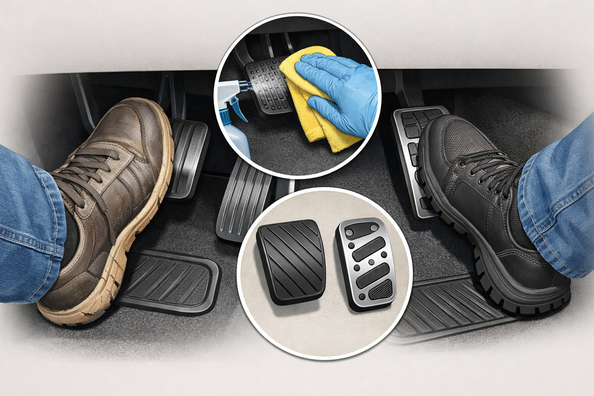
A slippery pedal and a sole that wears out quickly usually don’t have a single cause, but a combination of several: worn pedal rubber, moisture or dirt, unsuitable footwear, a floor mat out of place, or a poorly chosen aftermarket pedal cover. The issue seems minor—until you have to brake hard.
It’s not just about comfort. Before braking even begins, the driver already spends about 0.75 seconds reacting, and at 50 km/h the car covers about 10 meters in that time. If your foot also slips or catches a neighboring pedal, there’s almost no margin left.
Normally, a pedal should provide predictable grip with the sole: no foot sliding forward, no sideways slip, and no excessive friction that eats through your shoes. When the pedal surface becomes smooth, wet, or the wrong shape, that contact is compromised.
In everyday driving, the issue often shows up not constantly but depending on conditions: in rain, with snow on the sole, after interior cleaning, with winter shoes, or after installing universal covers. That’s why the same car can feel fine in dry weather and unpleasant at the very first wet traffic light.
DD Tuning expert comment: The most common mistake is buying the first pedal cover you see without checking whether it actually matches the shape and whether the rubber elements protrude above the metal. The second typical mistake is blaming the pedal when the floor mat or winter shoes with a wide sole are actually at fault. Before buying an accessory, it’s worth separating the cause with simple checks on a dry and wet sole.
| Symptom | Likely cause | What to do |
|---|---|---|
| Fine when dry, but in rain the foot slips off | Wet sole, smooth pedal, dirt packed into the tread | Clean the pedal area, don’t use silicone products, replace the worn rubber pad if needed |
| Slips all the time, even in dry shoes | Worn or smooth pedal pad, low-quality aftermarket cover | Check the tread, check for play, replace the factory rubber or install a quality cover with proper fitment |
| Foot catches a neighboring pedal or feels awkward | Bulky footwear, high heel, mat shifts the foot | Try different shoes, check the mat position and retention |
| The pedal feels “heavy” or the travel feels off | Mat slides under the pedal or is placed on top of another | Remove the extra mat, install the correct-size set, verify free pedal travel |
| The sole wears quickly in one spot | Aggressive metal, abrasive surface, sharp edges on the cover | Avoid overly harsh covers, switch to an option with rubber inserts and a gentler tread pattern |
The first practical step is a full cleaning of the pedal area and checking the floor mat. It’s cheap, quick, and often eliminates two causes at once: a slippery film on the pedals and an incorrect foot position.
The second real solution is replacing a worn factory rubber pad. If the tread is worn down, no “restoration” with care products will bring back proper grip for long. The same applies to a bad aftermarket cover: if it sits loose, don’t live with it—replace it.
Third: proper driving shoes. A closed heel, moderate sole thickness, no excessive width, and non-slippery materials give an immediate effect without touching the car. For daily driving, this is often the fastest way to eliminate the issue.
Silicone sprays, rubber “dressings,” and similar care products don’t solve the problem and often make the pedal even more slippery. They may improve appearance, but not safe contact.
Universal covers without precise fitment are also a bad idea. If an accessory has any play, you shouldn’t rely on it every day: it not only adds no control, it can shift at a critical moment.
Hard abrasive solutions can sometimes increase grip, but for a daily driver it’s often trading safety for accelerated shoe wear. If your sole starts wearing out in weeks rather than seasons, the surface choice is wrong.
If the factory rubber is already smooth or cracked, it makes sense to look at pedal covers. It only makes sense if the cover fits tightly, doesn’t wobble, and has pronounced rubber elements that actually protrude above the surface.
If slipping shows up together with water, snow, and dirt under your feet, start with the floor. In such conditions, rubber interior mats help when you need easy cleaning and moisture retention, or EVA mats when it’s important to trap snow and fine dirt better in the cells.
If the problem disappears with different shoes, it’s too early to spend money on pedals. Change your footwear first, and only then assess whether additional accessories still make sense.
| Solution | When it works | When it’s not worth spending money |
|---|---|---|
| Cleaning the pedals and the area around them | There’s dirt, road chemicals, wet film, small debris | The pedal is already smooth or the cover has play |
| Replacing the factory rubber pad | The tread is worn down, the rubber is cracked or hardened | The cause is the floor mat or unsuitable footwear |
| A quality pedal cover with rubber inserts | You need more grip and the factory surface isn’t enough | If the cover is universal, sits loose, or has smooth metal |
| Replacing the mat or securing it correctly | The mat slides, creeps under the pedal, lies on top of another | The mat is flat and doesn’t interfere, and slipping depends on the sole |
| Changing driving shoes | The problem occurs only with one pair of shoes | It also slips when dry and with other shoes because of the pedal itself |
From a customer’s experience: A person complained about a slippery gas pedal in autumn and rapid sole wear on everyday sneakers. After checking, it turned out the factory rubber was already smooth, and a poorly chosen accessory with a hard edge was installed on top; after switching to a tightly fitted cover with rubber inserts and a proper floor mat, the slipping disappeared and the shoes stopped wearing out in one spot.
Slippery pedals and worn shoes are almost always explained by specific things: worn rubber, moisture, unsuitable footwear, a floor mat, or a poorly chosen cover. The right sequence is simple: clean and check first, then separate the shoe issue from the pedal issue, and only after that spend money on replacement or accessories.
The material is based on real selection experience, practice, and real-world usage scenarios: in most cases, what helps isn’t a “magic” accessory, but a precise understanding of where grip is being lost—on the pedal, on the sole, or under your feet.
Shipping to EU
Wholesale and retail
Own warehouse
Опис продукту
Подарунки не надаються при оформленні покупки у кредит під 0,01% або при покупці частинами.