24.08.2026
104
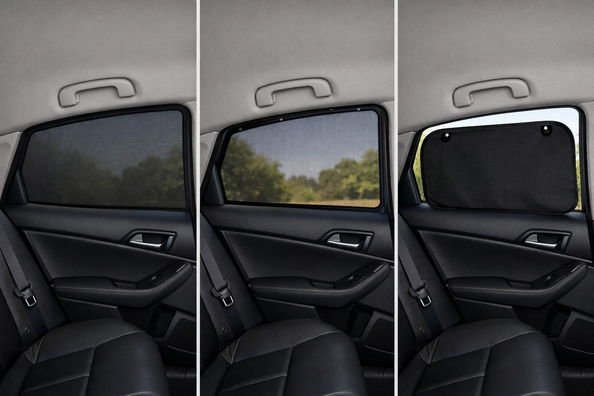
If the shades are meant specifically for daily driving and not just to darken the cabin while parked, model-specific mesh versions most often win. They fit the opening more precisely, leave fewer gaps along the edges, and don’t block visibility as aggressively as dense blackout solutions. Universal magnetic ones are more convenient where quick installation and the ability to slightly open the window matter, while thick curtains work better for sleeping, camping, or long parking under the sun.
The main confusion is that “model-specific” and “magnetic” are not always different classes. A magnetic shade can also be model-specific if it’s made for a particular body. So you should look not at the name, but at the fit, the mounting method, behavior while driving, and how you actually use the car.
In essence, you’re choosing between three different priorities. Model-specific shades win on precision: they usually follow the window shape better, let in less sun around the edges, and look neater in the cabin. Universal magnetic ones win on flexibility: they’re easy to install, remove, or move to another car, but the fit is rarely as tight. Dense blackout curtains win on maximum darkening and privacy, but that’s more of a parked-car story than a driving one.
So the question isn’t which shade is “best overall”, but what matters more to you: visibility and a tidy fit, speed of use, or near-total light blocking. For a rear row with kids and daily city trips it’s one choice; for trips with sleeping in the car it’s another.
It’s also worth considering the body type. For magnetic solutions, it’s important that there’s metal in the window frame and somewhere to attach securely. On frameless bodies or with a complex upper edge, even a shade that looks convenient can fit only so-so.
| Option | Strengths | Weaknesses | Who it’s for |
|---|---|---|---|
| Model-specific mesh | Precise fit, fewer gaps, decent visibility, stable look in the cabin | More expensive, tied to the car model and year, not transferable between cars | Those who drive daily and want sun protection without constant compromises |
| Universal magnetic | Quick to install and remove, can be moved between cars, often allow the window to be slightly opened | Worse fit, dependence on a metal frame, possible noise and shifting at speed | Those who need a convenient compromise for city driving, taxi work, or a second car |
| Dense blackout curtains | Maximum darkening, privacy, the best scenario for parking and sleeping | Reduce visibility, darken the cabin, inconvenient for regular driving | Those who often park under the sun, travel, sleep in the car, or carry an infant for daytime naps |
DD Tuning expert comment: the most common mistake is buying the darkest shade and expecting it to be comfortable for daily driving. The second typical miss is not checking exactly how the shade attaches to your window frame: in photos everything looks the same, but in a real car the difference between a tight fit and constant readjustment is huge. If the body is complex, it’s better to pay extra for an accurate shape than to save on universality that then becomes inconvenient to use.
This is the strongest option for those who want to install once and simply use it. If the shade is made for a specific window, it covers the edges better, lets in less angled sun, and doesn’t look like a temporary accessory. The mesh structure adds an important plus: the cabin doesn’t become pitch-dark, and the rear passenger can still see outside.
But model-specific solutions cost more and require an exact match by body, generation, and sometimes even by glass type. On complex windows, a small gap is still possible. Installation also varies: sometimes it’s retainers under the seal, sometimes a frame, sometimes magnets shaped for the specific form.
The strong side of magnetic solutions is everyday convenience. They’re easy to put on before a trip, quick to remove, and in many cases you can slightly open the window without removing the shade completely. That’s exactly why they’re often liked by those who drive in the city, carry kids, or want one shade for several cars.
The weak point is dependence on the door design. If there’s little metal at the top or the frame geometry is inconvenient, the shade may not sit tightly. On the move, that means gaps, movement, and sometimes extra noise. In winter, there’s another practical point: interior shades can pick up moisture from condensation, so it’s important that they can be quickly removed and dried.
This is the best format not for driving, but for parking. If the task is maximum darkening, privacy, a child’s sleep, or sleeping overnight in the car, a dense curtain delivers the effect that mesh won’t. This is where a high level of blackout truly makes sense.
But for everyday use it’s the least universal scenario. Visibility becomes worse, the cabin gets too dark, and suction-cup or soft-element mounting doesn’t always hold equally well in heat. So blackout should be seen as a separate tool for a specific task, not as a permanent everyday solution.
For daily trips, especially when kids often sit in the back, model-specific mesh shades work best. They don’t require constant attention, don’t annoy as much with edge gaps, and don’t turn the cabin into a dark capsule. It’s the best balance between sun protection and normal visibility.
If you have multiple cars, need to move the shade often, or it’s crucial for you to occasionally lower the window, a universal magnetic one is more practical. It will rarely sit as cleanly as a model-specific one, but in everyday life it often turns out to be more convenient.
For trips to the seaside, parking under open sun, sleeping in the cabin, or camping, it’s more rational to have a separate dense blackout set. It doesn’t replace shades for driving, but it solves a different task—total darkening where it’s truly needed.
| Scenario | What’s best to choose | Why |
|---|---|---|
| Daily city driving | Model-specific mesh | Fits better, doesn’t require constant adjustment, preserves visibility |
| A child naps in the rear row during the day | Model-specific mesh or blackout for parking | While driving, visibility matters; when parked, maximum darkening matters |
| Need to slightly open the window often | Universal magnetic | Easier to combine with partially lowered glass if the door frame allows it |
| One shade for two cars | Universal magnetic | Model-specific ones are too tied to a specific body |
| Camping or sleeping in the car | Dense blackout curtains | Provides maximum darkness and privacy that mesh doesn’t |
| Complex glass shape and edge sun stripes are annoying | More expensive model-specific solutions | Here, the exact shape matters more than universality |
Paying extra is justified when the shades are used every day, not just a few times over the summer. If the car regularly sits in the sun, kids often ride in the back, or edge light strips annoy you, it’s better to look at the sunshade category right away instead of grabbing the first universal kit.
Another case where you shouldn’t cheap out is a complex window shape. That’s where you really see the difference between a semi-universal solution and a shade that follows the contour. To understand what selection for a specific body looks like, it’s useful to check model-specific shades for your car, and if you want to verify the selection logic first, there’s a separate breakdown of which shades really work against the sun.
A more expensive solution makes sense not when you want “premium”, but when it actually removes daily discomfort: gaps, noise, constant re-sticking, or taking it off before every trip.
From a customer’s experience: a common scenario is that people first buy universal magnetic shades because they want cheap and fast. For a second car or rare trips it’s fine, but on the main car people often switch to model-specific mesh because they get tired of edge gaps and readjusting after every time the window is lowered. In the end, the universal ones stay as a backup, and for everyday use they install what fits better.
If you need one short takeaway, it’s this: for daily driving, model-specific mesh shades are most often the right choice; for quick installation, moving between cars, and a partially open window—universal magnetic; for parking, sleeping, and total blackout—dense blackout curtains.
The worst approach is choosing only by blackout level or only by price. Real-world results come down to fit, mounting method, behavior while driving, and whether the shade matches your scenario. This material is based on real selection experience, practice, and real use cases.
| ✔ | Model-specific mesh curtains fit the opening better and leave fewer gaps along the edges. This is practical for everyday driving, when you don’t want to keep adjusting the curtain. |
| ✔ | Mesh model-specific versions darken the cabin less than blackout ones, so rear passengers can still look outside. For trips with children, this is more convenient than a fully dark cabin. |
| ✔ | Universal magnetic curtains are easy to install and remove, and can also be moved between different cars. This is useful if the curtain is needed for more than one vehicle or is used irregularly. |
| ✔ | Magnetic solutions often let you open the window slightly without fully removing the curtain. This is convenient in the city or in warm weather, when ventilation is needed. |
| ✔ | Dense blackout curtains provide maximum darkening and privacy. They are best suited for sleeping in the car, camping, or long-term parking in the sun. |
| ✘ | Model-specific curtains are more expensive and tied to a specific model, generation, and sometimes glass type. They can’t just be moved to another car. |
| ✘ | Universal magnetic curtains fit worse than model-specific ones and depend on the presence of a metal frame. While driving, this can cause shifting, gaps, or noise. |
| ✘ | Dense blackout curtains are too dark for regular driving, as they reduce visibility and make the cabin less comfortable. It’s better to see them as a solution for parking or sleeping, not for everyday use. |
| ✘ | On complex body shapes or windows without a proper frame, even a convenient curtain may fit only so-so. In that case, universality often loses to a precise fit. |
Shipping to EU
Wholesale and retail
Own warehouse
Опис продукту
Подарунки не надаються при оформленні покупки у кредит під 0,01% або при покупці частинами.