24.08.2026
152
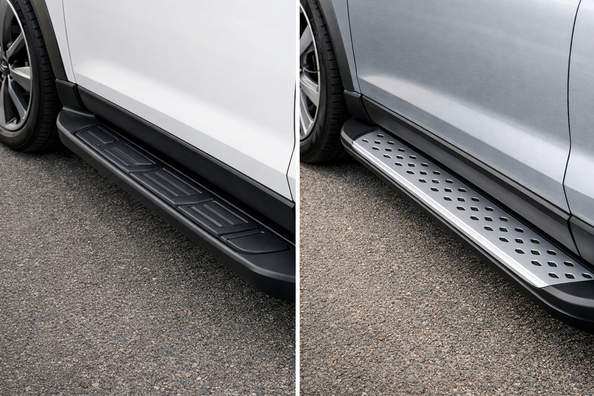
For everyday driving, the choice between ABS plastic and aluminum side steps comes down not to a trendy material, but to three things: how often you actually step on the step, what foot support width you need, and how important a stiffness reserve is. If your priority is lower weight, easy care, and minimal rust risk, ABS or a composite option is often the more logical choice. If the step will be used daily—for family use or under higher loads—aluminum more often wins.
The most common mistake with these purchases is looking only at the material and missing the geometry, mounting, and compatibility. Those are exactly what determine whether the step will be comfortable, whether it will start rattling, and whether it will end up collecting snow, dirt, and impacts from below.
ABS steps are chosen for a lighter construction, no rust on the outer surface, and calmer day-to-day city use. But it’s important to understand that on the market this is often not “pure plastic” but a composite assembly: ABS on the outside, with a metal reinforcement or subframe inside. So real strength depends not only on the plastic, but on the whole assembly.
Aluminum steps have a much larger reserve of strength and stiffness in the material itself. In practice, that usually means a more confident step, a wider platform, and better behavior with frequent entries and exits. The downside is higher weight, a higher price for well-made kits, and the risk of losing ground clearance if the platform sits low and protrudes far.
| Option | Strengths | Weaknesses | Who it suits |
|---|---|---|---|
| ABS plastic or composite | Lower weight, outer surface doesn’t rust, often easier no-drill installation, sufficient for city driving | Lower stiffness reserve, sensitive to plastic quality and sun exposure, step width is often more modest | For those who drive mostly in the city, rarely step on the sill, and don’t want extra hassle with corrosion |
| Aluminum | Higher stiffness and strength, often a wider platform, better for frequent use and higher loads | Heavier construction, a good kit costs more, possible reduction in ground clearance, weak point is steel brackets | For families, owners of taller vehicles, those who often use the step or want a noticeably more reliable support |
DD Tuning expert comment: most often, buyers make a mistake when they read only the material name and don’t look at the brackets, platform width, and fit for a specific body. The second typical story is focusing on a single load rating number without checking the kit description, because product cards sometimes contain discrepancies. And third: if a step rattles, the issue is usually installation or fastening, not the ABS or aluminum itself.
ABS has a lower density, so the material itself is lighter. For a daily driver, that’s a plus: less weight, easier installation, and calmer use with no rust on the outer surface. Such steps are often installed into factory points without drilling, and for city use and moderate loads this is completely sufficient.
But the strength and stiffness reserve of ABS is lower than that of 6061 aluminum. Put simply, a plastic or composite step feels better where people aren’t jumping on it every day with full body weight and where a very wide platform isn’t required. Another nuance is aging in the sun: exterior durability depends heavily on whether the plastic is UV-stabilized.
In practice, what matters is something else: a good ABS assembly is not necessarily “weak,” because it often has metal reinforcement. So don’t just look at the ABS label—look at the actual construction, brackets, and the rated load for that specific kit.
6061 aluminum is significantly stiffer and stronger than ABS, so aluminum steps make sense where the step is truly used. Applied designs often also feature a wider platform: that’s more convenient for kids, older passengers, and for a driver getting into a tall vehicle several times a day.
In terms of corrosion resistance, aluminum itself behaves well, but in practice it’s not the platforms that wear first—it’s the steel brackets and bolts. That’s why for winter use it’s important not only to have the aluminum part, but also corrosion protection for the entire kit. Without it, the material advantage partly disappears.
The main compromise with aluminum is weight and geometry. If the platform is wide and set low, comfort will be better, but on bad roads it will more often collect dirt and ice and may catch obstacles.
For a city crossover where the step is more about looks and only occasionally used as a step, there’s often no point in overpaying for a heavier construction. Here ABS or a composite option covers the basic need: easy installation, normal practicality, and less hassle with rust.
If the vehicle is tall, kids or older passengers get in often, or you regularly step on it in winter footwear, aluminum looks more logical. Not because “plastic is bad,” but because in everyday convenience and stiffness a wide aluminum platform usually feels noticeably better.
For rough roads, what becomes critical is not so much the material as the height and protrusion of the step. It’s better to choose a narrower or higher-mounted option than a wide, good-looking platform that regularly catches snow, curbs, and ruts.
| Scenario | What to choose | Why |
|---|---|---|
| City driving, step is used rarely | ABS plastic or composite | Lighter, functionally sufficient, outer surface doesn’t rust, usually no reason to overpay |
| Family vehicle, daily entry for kids and older passengers | Aluminum | A wider and stiffer step is more convenient in real use |
| Winter use with salt and de-icers | Aluminum or composite, but only with quality brackets | The material matters, but durability here is decided most by bolts, coatings, and protection of the mounts |
| Bad roads, ruts, off-road near home | A higher and more compact option regardless of material | A low wide platform is less practical because it hits obstacles and collects ice |
| Maximum foot support is needed | Aluminum | More often has a wider platform and greater stiffness reserve under load |
A more expensive kit is justified when the step is not décor for you, but a daily working component. This primarily includes family vehicles, tall crossovers and SUVs, frequent winter driving, and regular use of the step under load. In that case, it’s important to pay not just for the material, but for assembly stiffness, precise fit, proper brackets, and a well-chosen platform width.
If you want to browse the full range and start from the construction type, begin with the side steps catalog. For typical everyday use, side steps most often make sense, and if you need a bigger strength reserve and durability on bad roads, it’s worth taking a separate look at heavy-duty steps.
From a customer’s experience: the owner of a tall crossover initially wanted a light ABS option only because of the lower weight, but after clarifying the use case it turned out that kids and parents get into the car every day, and in winter the car drives on roads treated with reagents. In the end, he chose a wider aluminum kit with proper brackets, because entry comfort mattered more than the small difference in weight. Satisfaction came not from the word “aluminum,” but from the correctly selected width and fit of the step.
For everyday driving, an ABS or composite step is worth choosing when you need a lighter construction, easy care, and sufficient functionality without extra demands for stiffness. Aluminum makes sense where the step is truly used every day: frequent entry, a taller vehicle, higher user weight, and the need for a wider, more confident support.
The key to the right choice is not the material by itself, but the combination of geometry, mounting, compatibility, and your use scenario. This material is based on real selection experience, practice, and real-world use cases, so the takeaway is simple: for city driving and a calm routine, a quality ABS solution is often enough, while for active daily use a good aluminum kit is more often justified.
| ✔ | ABS sills are lighter, so they add less weight to the car and are usually more convenient for everyday use. For city driving, this is a practical option without unnecessary load. |
| ✔ | The outer part of ABS or composite does not rust, so it is easier to maintain in city conditions and with road salts. This reduces the risk of corrosion on the visible part of the sill. |
| ✔ | Many ABS kits are installed in the factory mounting points without drilling. This makes installation easier and reduces the chance of making a mistake during fitting. |
| ✔ | Aluminum sills have higher rigidity and strength, so they are better suited for frequent entry and exit. In real use, this gives more confident support for the foot. |
| ✔ | Aluminum often provides a wider platform, which is more convenient for children, older passengers, and tall cars. Such a step is more practical when the sill is used every day. |
| ✘ | ABS has less stiffness reserve than aluminum, so it is less suitable for frequent load. If people often step on the sill with their full weight, this is a noticeable drawback. |
| ✘ | The durability of ABS depends more heavily on the quality of the plastic and resistance to sunlight. Without proper UV stabilization, the material can age faster. |
| ✘ | Aluminum sills are heavier, and good kits usually cost more. This increases the cost of the solution without a direct benefit if the sill is used rarely. |
| ✘ | A wide and low-mounted aluminum platform can reduce ground clearance and collect dirt, ice, and snow more often. On poor roads, this becomes a practical problem. |
Shipping to EU
Wholesale and retail
Own warehouse
Опис продукту
Подарунки не надаються при оформленні покупки у кредит під 0,01% або при покупці частинами.