10.05.2026
360
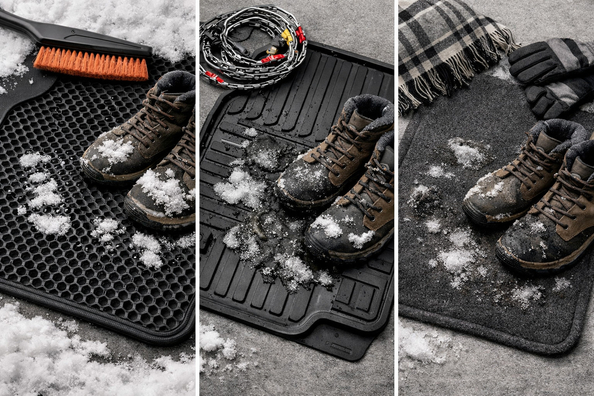
For winter, what matters is not so much the label on the box as the mat’s fit to the floor, the sidewall height, and the presence of fasteners. If you need the simplest and most practical option for snow, water, and salt, high-quality rubber or TPE solutions most often win. If you want a softer cabin feel and less noise underfoot, EVA is worth considering too—but only in a properly made version for your specific model.
Textile mats don’t disappear in winter for a reason: they look nicer and feel better underfoot, but in a truly wet winter they lose out faster in terms of care and protection. So the question isn’t “which material is trendier,” but “how much water, slush, and salt you deal with—and how often you’re ready to clean the interior.”
A winter floor mat has to do three things: keep water and salt from getting underneath, not slide around under the pedals, and clean up quickly. If even one point fails, the material won’t save it. That’s why an exact, model-specific cut is often more important than a fancy material name.
Universal winter mats most often lose because of geometry: exposed edges near the sills, weak coverage of the left footrest area, low sidewalls. The result is dirt ends up under the mat, not on it. So the essence of the choice is simple: fit and safety first, then practicality, and only then comfort and looks.
| Option | Strengths | Weaknesses | Who it’s for |
|---|---|---|---|
| Rubber or TPE | Hold water, salt, and dirt well; wash quickly; work нормально in мороз; straightforward to use | Stiffer to the touch; in cheap or universal versions, edge coverage is often weak | Anyone who drives daily in winter, walks through slush a lot, and doesn’t want to spend time on maintenance |
| EVA | Cell structure traps water and sand; often softer and quieter; in good builds provides large coverage | Quality depends heavily on the maker; if the sidewalls or cut are weak, the advantage disappears; dirt needs to be shaken out of the cells regularly | Those who want winter practicality but don’t like a stiff “utilitarian” format |
| Textile | Nicer look, softer underfoot, a calmer-looking interior | Absorbs moisture, salt, and dirt; takes longer to dry; hardest to clean in winter | For a dry city winter, short trips, or as a secondary set |
If you boil it down to one line: for most winter scenarios, first place goes to quality rubber or TPE mats, second to well-made EVA, and textile remains a choice for those whose winter is truly dry—or who are willing to accept the upkeep for the sake of looks.
DD Tuning expert comment: most often people make the mistake not with the material, but with the format. They buy a universal mat, look only at the price, and don’t check whether there are sidewalls, proper fasteners, and coverage near the sill. The second common mistake is leaving the old mat under the new one: this increases the risk of slipping, and overall winter protection works worse.
This is the most straightforward winter tool. Good models have a pronounced sidewall, water channels, and an anti-slip underside, and the material stays flexible even in deep sub-zero temperatures. That’s why they’re most often chosen for daily driving, highway use, taxi work, family cars, and any scenario where people constantly step in with wet shoes.
The weak point isn’t the material itself, but cheap execution: low edge, poor geometry, weak retention. Then water goes under the mat instead of staying inside it. In feel, this is the least “soft” option, but it’s the most predictable to maintain.
EVA wins with its honeycomb surface: water, snow, sand, and fine dirt don’t spread across the whole area, but collect in the cells. Some manufacturers claim high capacity and good cold performance, but those numbers strongly depend on the thickness, density, and construction of the specific set. In practice, it’s a solid winter compromise between protection and comfort.
EVA’s strong point is cabin feel: it’s often softer and quieter than rigid all-season mats. But if the mat is thin, has poor edging, or doesn’t fit the floor contours well, the effect is lost. For winter, EVA makes sense to choose not “for the material,” but for precise fit and a well-thought-out shape.
A textile mat looks the nicest and is often the most comfortable underfoot, but in winter it’s already a compromise. It absorbs water and salt, needs vacuuming, chemicals, and drying, and in wet weather quickly loses its tidy appearance. If the car sees a lot of snow and road chemicals, textile either needs very frequent care—or you accept that protection will be mediocre.
Where winter is dry, trips are short, and it’s important to keep a more “passenger-car” feel inside, textile can still make sense. But as the only winter set for wet conditions, it’s the weakest of the three.
For everyday winter city driving, when you regularly bring water, salt, and dirt into the cabin, rubber or TPE mats with a high sidewall will give you the least hassle. If the conditions are the same but you want a softer cabin and a less “heavy-duty” feel, it makes sense to look at quality EVA with a precise cut.
For highway driving, frequent trips out of town, a family car with kids, or a commercial vehicle, fast cleaning is the key. Here rubber solutions are usually ahead. Textile is appropriate where winter is truly dry, mileage is low, and the driver is willing to live with regular cleaning for the sake of appearance.
If you want one set for a long time, don’t look at a “nice-looking material,” but at the design’s service life: proper thickness, edge rigidity, compatibility with mounts, and exact floor coverage matter more than any promises in the description.
| Scenario | Best choice | Why |
|---|---|---|
| Daily city driving in slush | Rubber or TPE | Easiest to pull out, rinse, and put back; holds water and salt well |
| Wet winter, but you want a quieter cabin | EVA | Better underfoot comfort while staying practical if there’s a precise cut and sidewalls |
| Highway, country house, frequent stepping out in dirty shoes | Rubber or TPE | Less maintenance hassle and lower risk of soaking the floor |
| Dry city winter, short trips | Textile | Can be enough if the priority is looks and softness, not maximum winter protection |
| Family car, kids, sand, snow, snacks on the road | Rubber or TPE or EVA | Both formats are much easier to clean than textile; the choice depends on desired comfort |
| One set for year-round use without extra care | Rubber or TPE | The most universal and predictable option in terms of price and maintenance |
Paying extra is justified when the car truly lives in winter: daily trips, lots of in-and-out, kids, passengers, trips out of town, wet footwear, and a desire not to scrub the floor every week. In that scenario, a pricier solution pays back not with “status,” but with better floor coverage, higher sidewalls, faster cleanup, and a lower risk of water getting underneath.
The selection logic is simple: if you need maximum practicality, look at rubber mats; if you want more comfort and a softer cabin feel without giving up winter functionality, take a look at EVA mats; and if your winter is dry and the priority is cabin feel, then textile mats make sense. A more expensive set isn’t needed only when the car drives little, winter is mild, and the interior barely sees water and salt.
From a customer’s experience: a driver was looking for a winter set for daily city driving and initially wanted textile because it looked neater. After the first assessment of the use case, it became clear that snow and road chemicals constantly get into the cabin, so he chose a model-specific all-season set with a high sidewall. In the end, he’s happy not with the “material,” but with the fact that the floor stays dry and everything cleans up in a few minutes.
If you need a short answer: for most winter conditions, quality rubber or TPE mats perform best; EVA is worth it for those who want more comfort and a quieter cabin; and textile remains an option for a dry winter or as a secondary set. The main criterion is one: precise vehicle-specific fit, a high sidewall, and reliable retention.
This conclusion is based on real selection experience, practical use, and real-world scenarios: in winter, the winner isn’t the prettiest material, but the set that doesn’t slide around, doesn’t let water under it, and doesn’t take half an hour for every cleanup.
| ✔ | Rubber or TPE mats do the best job of trapping water, salt, and dirt, and they can be quickly washed after driving in slush. For everyday winter use, this is the least troublesome option. |
| ✔ | EVA mats can be a good compromise between protection and comfort: the cells hold water and sand, while the material itself is often softer and quieter than rigid rubber. |
| ✔ | Textile mats look neater and feel nicer underfoot, so they can be suitable for a dry city winter or when the cabin appearance matters more than maximum protection. |
| ✔ | For a family car, highway driving, or frequent trips out of town, models with a high edge and precise fit are more practical, as they cover the floor better and let less moisture get under the mat. |
| ✔ | The article clearly shows that the main thing is not the material itself, but the fit for a specific model, the mounting points, and the edges, so the choice can be made more consciously for your own conditions. |
| ✘ | In winter, textile absorbs water, salt, and dirt, which makes it dry longer and requires regular vacuuming and drying. In wet weather, it quickly loses its neat appearance. |
| ✘ | EVA depends heavily on the quality of the specific manufacturer: if the material is thin, the edging is weak, or the cut is poor, its advantages quickly disappear. |
| ✘ | Cheap or universal rubber/TPE mats may have weak edge coverage and poor geometry, which means water can still get underneath them. |
| ✘ | Universal mats generally lose out to model-specific ones because of open edges, low side walls, and weak coverage of the area near the sill, which is especially critical in winter. |
Shipping to EU
Wholesale and retail
Own warehouse
Опис продукту
Подарунки не надаються при оформленні покупки у кредит під 0,01% або при покупці частинами.