22.07.2026
123
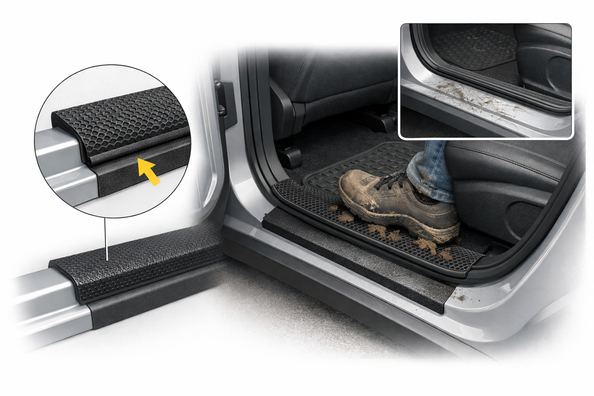
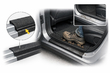
EVA threshold mats really do help, but not with everything. They do a good job of holding back water, sand, and dirt in the area by the doors—if they’re made for a specific model, are properly secured, and actually extend onto the edge of the door opening. As for scratches on the painted threshold itself, such a mat only helps partially: shoes still rub against the paint where the mat doesn’t cover the contact area.
So it’s important not to mix up two different tasks here. If you want less dirt in the cabin and on the inner edge by the door, an EVA threshold section makes sense. If the goal is to protect the paint from daily scuffing, it’s more logical to look at a separate scuff plate or protective film for the threshold.
Dirt on the threshold doesn’t appear because the main floor mat is “bad,” but because some moisture and sand enter the cabin from the side when getting in and out. Most often you notice it in winter, in slush, on dirt roads, and in cars where the doors are opened many times a day. The center of the floor can still be relatively clean, while the edge by the door is already full of sand.
Scratches are a different story. They’re caused not by water, but by mechanical contact: soles, heels, bags, child seats, tools. If a person regularly hits the upper painted part of the threshold, a cabin floor mat can’t fully take that abuse on itself.
DD Tuning expert comment: The most common mistake is buying a mat with an extra lip and expecting it to remove dirt, preserve the paint, and require no maintenance at the same time. In practice, the deciding factors are an accurate pattern, proper fasteners, and understanding that protection from dirt and protection from scratches are not the same accessory. Another typical mistake is installing a mat on a dirty or damp base and then being surprised it shifts.
| Symptom | Likely cause | What to do |
|---|---|---|
| Dirt collects specifically by the door | Water and sand enter from the side when getting in | Install a vehicle-specific EVA mat with an overlap onto the threshold and proper fastening |
| Scuff marks remain on the threshold paint | Contact happens on the painted area the mat doesn’t cover | Add a separate scuff plate or protective film on the threshold |
| The mat slides or squeaks | Weak fasteners, dirty underside, inaccurate pattern | Clean the base, check factory retainers or Velcro, don’t stack a second layer |
| There’s almost no difference after installation | Low threshold or dry usage conditions | Don’t overpay for a threshold section if dirt doesn’t reach that area |
| The driver’s side wears out quickly | Point load under the heel | Add reinforcement in the heel area |
It’s not just “EVA” that works, but the right combination. First, a model-specific pattern: the mat must cover the exact area where dirt actually enters. Second, fastening: factory mounts or quality Velcro matter more than loud claims about edge height. Third, regular cleaning: if the cells are clogged with sand and salt, they no longer work as they should.
Universal mats without an accurate pattern have a weak effect in the threshold area because they leave gaps or shift. The “I’ll get a higher edge and that’ll be enough” approach works just as poorly: without stable fastening it doesn’t solve the problem. There’s also little point in buying an extra threshold section only for dry city driving if most of your dirt already stays on a regular mat.
Stacking mats on top of each other doesn’t help either. It reduces stability, prevents proper seating of the element, and can create extra movement underfoot. It’s also not worth trimming a mat yourself hoping to “make it fit”: usually after that it holds worse and deforms faster.
If your goal is to keep the area by the doors drier and cleaner, look at EVA threshold mats: they’re appropriate where dirt really comes in from the side. If you need to cover the entire floor with one solution, it makes more sense to start with model-specific EVA cabin mats rather than a separate section. If the problem is local and all the trouble is in the driver’s heel area, it’s enough to get an EVA heel pad instead of changing the whole set.
Replacing or adding separate protection on the threshold itself makes sense when the paint is already dull, scratched, or regularly hit by shoes. In that case, the cabin accessory solves dirt, and the protective element on the threshold solves coating wear. These are two different tasks, and it’s better to separate them right away.
| Solution | When it works | When it’s not worth spending money |
|---|---|---|
| EVA threshold section | Slush, winter, dirt roads, frequent entry/exit, dirt comes in from the side | Dry city driving, low threshold, dirt doesn’t reach the door edge |
| Full model-specific EVA set | You need to control water, sand, and snow across the entire floor | If the problem is only the painted threshold, with no dirt in the cabin |
| Separate scuff plate or protective film for the threshold | There are constant shoe scuffs, paint protection is needed | If only dirt underfoot is annoying, not scuffs on the threshold |
| Heel pad | The driver’s area wears in one spot | If there’s no localized heel wear |
| Regular washing and drying | You need to maintain fastening and normal cell function | Won’t help if the mat itself is inaccurate or constantly shifting |
From a customer’s experience: they were looking for a solution not for scratches, but for wet sand that kept collecting by the doors after short trips around the city and out of town. After switching to a model-specific EVA option with an overlap onto the threshold, the area by the doors became cleaner—but for the painted threshold they separately added a protective element because shoe marks remained. The biggest difference was felt in winter, not in summer.
EVA threshold mats protect against dirt and moisture better than against scratches. If you have a wet season, frequent entry/exit, and dirt accumulates specifically by the doors, they work and deliver a noticeable effect. But if the main problem is paint wear on the threshold itself, it’s better to install separate protection right away rather than expecting that from a cabin mat.
Put simply: for cleanliness—yes; for paint protection—only partially. This material is based on real selection experience, practical work, and real usage scenarios, so the key takeaway is: first determine what exactly annoys you—side dirt or paint scuffs—and then choose the solution accordingly.
| ✔ | They do a good job of holding back water, sand, and dirt in the door area if the mat is model-specific and properly secured. This is especially noticeable in winter, slush, and on dirt roads. |
| ✔ | They help keep the edge by the doors cleaner, where the main mat often does not cover the side entry of dirt. For getting in and out in wet weather, this is a practical solution. |
| ✔ | They make sense as part of a proper protection set together with secure fastening and regular cleaning. If the cells are not clogged with sand and salt, they work noticeably better. |
| ✔ | They are suitable for scenarios with frequent short trips, children, taxis, or trips out of town. In such conditions, dirt by the doors builds up faster, so the effect from them is more noticeable. |
| ✘ | They only partially protect against scratches on the painted sill itself. Shoes can still rub against the paint where the mat does not cover the contact area. |
| ✘ | They do not work properly without an exact template and stable fixing. If the mat shifts, bends, or pulls away from the edge, there is almost no benefit from it. |
| ✘ | In dry city driving or on cars with a low sill, the extra section often brings little noticeable benefit. In such cases, it may be an unnecessary expense. |
| ✘ | They do not solve the problem if the main wear comes under the driver’s heel or if you specifically need paint protection. For this, you need a separate heel pad or a film/overlay on the sill. |
Shipping to EU
Wholesale and retail
Own warehouse
Опис продукту
Подарунки не надаються при оформленні покупки у кредит під 0,01% або при покупці частинами.