23.07.2026
164
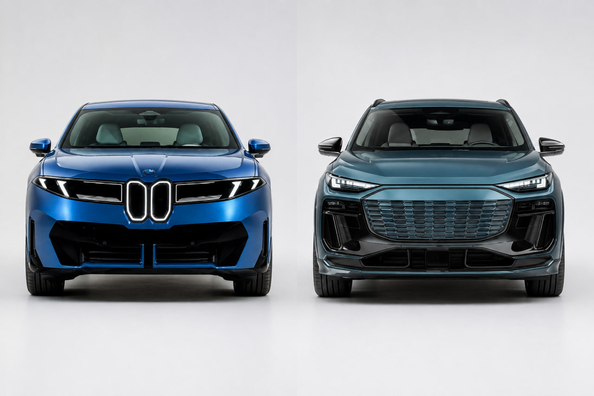
In short, the BMW iX3 50 xDrive and Audi Q6 e-tron quattro are close in class, but not in character. The BMW is stronger as an electric crossover for highway driving and frequent long trips: it has a larger battery, longer range, higher peak fast-charging power, and a factory NACS port in the US. Audi wins differently: with a quieter cabin, a calmer ride, and a more relaxed everyday feel.
For a fair comparison, it matters that the BMW arrives in the US in fall 2026 as a 2027 model, while the Audi Q6 e-tron already sits on a clearer series-production foundation. So here, it’s not tenths of a second to 100 km/h that decide the difference, but charging compatibility, noise, practicality, price, and how willing you are to accept the risk of early software quirks in a new model. It’s convenient to check the official details via BMW iX3 and Audi Q6 e-tron.
The BMW iX3 is worth a look for those who want one car for both city and highway without constantly planning every charging stop. It has 112.2 kWh of usable energy, an estimated EPA range of 383–434 miles depending on wheels, DC fast charging up to 400 kW, and a standard NACS connector for the North American market.
The Audi Q6 e-tron quattro looks more logical for a buyer who values quietness, a calmer ride, and the feel of a mature premium crossover day to day. It also has an 800-volt architecture and fast charging, but with a 94.4 kWh net battery and 325 miles EPA range on 19-inch wheels, its strength isn’t maximum distance—it’s a comfort-focused delivery.
| Option | Strengths | Weaknesses | Who it suits |
|---|---|---|---|
| BMW iX3 50 xDrive | Larger battery, longer range, up to 400 kW DC, standard NACS, AC up to 15.4 kW, lower starting price, bidirectional power | Firmer ride, less “plush” over broken pavement, early model with risk of initial software glitches, towing up to 2000 kg | For those who drive the highway often, use public charging, and want maximum all-around versatility |
| Audi Q6 e-tron quattro | Quieter cabin, calmer ride, very good day-to-day comfort, 526 L trunk plus 64 L front, towing up to 2400 kg | Shorter range, up to 270 kW DC, in the US a more complex compatibility setup via CCS1 and an adapter, higher starting price | For those who want a premium electric crossover for city and highway without focusing on maximum range |
BMW’s main argument isn’t power by itself, but the combination of range, charging, and on-route convenience. 463 hp and 4.7 s to 100 km/h are nice, but what matters more is this: a 112.2 kWh usable battery, a long range, DC fast charging up to 400 kW, standard NACS, and support for V2L, V2H, and V2G. For someone who truly drives the highway often, it reduces the number of compromises.
BMW’s weaker point isn’t the numbers—it’s the character. First impressions suggest it’s not as soft as the Audi and can feel harsher over waves or potholes. Plus, it’s a completely new product, so the risk of small launch-phase software issues is higher than with a model that’s already established in the market. Practicality is solid: 520–1750 L trunk, 58 L front, towing up to 2000 kg.
Audi answers not with range, but with quality of daily life. 456 hp and 4.9 s to 100 km/h mean there’s no lack of pull here; the main feeling is quietness, calm, and less fatigue on the highway. For many, that matters more than a few extra dozen kilometers of range. On top of that, the Q6 e-tron has dimensions very close to BMW, good cabin space, and a strong practical side: 526 L trunk, 64 L front, and up to 2400 kg towing.
Audi’s compromise is clear: 94.4 kWh net, 325 miles EPA on 19-inch wheels, and DC up to 270 kW—enough, but with less reserve on the highway. In the US, there’s also a less convenient charging setup: the car is designed around CCS1, and access to part of the NACS networks comes via an adapter and sometimes a separate app. If this is your everyday city/suburban car, it’s a minor issue; if you often travel far, it becomes noticeable.
| Parameter | BMW iX3 50 xDrive | Audi Q6 e-tron quattro |
|---|---|---|
| Price in the US | $61,500 + $1,350 delivery | $64,500 starting price |
| Power | 463 hp | 456 hp |
| 0–100 km/h | 4.7 s | 4.9 s |
| Battery | 112.3 kWh gross / 112.2 kWh usable | 100 kWh gross / 94.4 kWh net |
| EPA range | 383–434 miles | 325 miles |
| DC charging | Up to 400 kW | Up to 270 kW |
| AC charging | Up to 15.4 kW | 11 kW |
| Trunk | 520–1750 L | 526 L |
| Frunk | 58 L | 64 L |
For frequent long trips, BMW is better. It simply has a larger energy reserve and less friction in the “get in and go far” scenario.
For city, suburbs, and a calm daily pace, Audi looks more appealing. It’s quieter and doesn’t push a driver-focused character where it isn’t needed.
As a one-car-for-everything solution, BMW looks more versatile—but only if public charging and highway driving matter to you. If comfort and occasional towing are priorities, Audi has a real argument.
For a cautious buyer, Audi is the calmer choice. BMW is more interesting for those willing to be early owners in exchange for better numbers and a more modern charging logic.
| Scenario | What’s better to choose | Why |
|---|---|---|
| Mostly city driving and short daily routes | Audi Q6 e-tron quattro | A quieter cabin and calmer ride deliver more daily comfort than extra range |
| Weekly long highway trips | BMW iX3 50 xDrive | A larger battery, longer range, and more convenient charging compatibility mean fewer stops and simpler routing |
| Frequent use of public chargers in the US | BMW iX3 50 xDrive | Standard NACS and higher peak power are more convenient than CCS1 plus adapter |
| Family vehicle with occasional towing | Audi Q6 e-tron quattro | Higher allowable towing capacity with similar cabin and cargo space |
| One electric crossover for all seasons | BMW iX3 50 xDrive | More energy reserve gives more buffer in winter and at highway speeds |
| You don’t want to be an early tester of a new model | Audi Q6 e-tron quattro | BMW has more uncertainty due to a fresh platform and early reports of software nuances |
Paying more makes sense when the pricier configuration truly saves you time or fatigue. If in your scenario that’s BMW, the logic is simple: lots of highway driving, frequent fast charging, one car for all roles. If the more expensive one is Audi, the justification is also clear: you’re paying for a quieter, calmer daily ride and a better overall feel in the city and on the highway.
There’s also a second part of ownership costs that people often mention too late: not appearance packages, but practical add-ons. For daily use, it’s more useful to immediately look at rubber floor mats for BMW iX3, a trunk mat for Audi Q6, and understand how cold weather affects an electric vehicle. In an expensive electric crossover, these kinds of things often bring more real value than flashy options.
The BMW iX3 50 xDrive is stronger where an EV needs to be максимально versatile: highway driving, frequent trips, public charging, winter, one car for everything. The Audi Q6 e-tron quattro is the more logical pick if you’re primarily buying quietness, a calm ride, and a premium day-to-day feel. Remember three things: look at your route, verify charging compatibility, and don’t overvalue pretty options where noise, practicality, and real usability matter more.
| ✔ | BMW iX3 has a larger battery, longer range, and higher peak DC charging power. This makes it more convenient for frequent long trips and routes with public charging. |
| ✔ | BMW in the US comes standard with NACS, so connecting to part of the networks is easier than with Audi using CCS1 and an adapter. For everyday use, this reduces the number of small inconveniences. |
| ✔ | The Audi Q6 e-tron is quieter and smoother on the road, so it is better suited for the city, suburbs, and a calm daily routine. It has a more relaxed feel behind the wheel. |
| ✔ | Audi has stronger towing capacity and slightly better practical capacity: 2400 kg versus 2000 kg in the BMW, as well as a larger frunk. This is useful for a family or utility-oriented scenario. |
| ✔ | BMW is cheaper upfront, if you look at the listed prices in the US. This provides a better balance of price and capabilities, especially if range and charging convenience matter. |
| ✘ | Audi falls behind BMW in range and maximum DC charging speed. On the highway, this means more compromises and potentially more time spent charging. |
| ✘ | In the US, Audi’s charging setup is less convenient because of CCS1 and the need for an adapter for part of the NACS networks. If you often drive long distances, this adds extra steps in use. |
| ✘ | BMW is a completely new model, so there is greater uncertainty around initial software nuances. For a cautious buyer, this is a real risk compared with Audi’s more mature platform. |
| ✘ | BMW is tuned more firmly over bumps and does not smooth out rough surfaces as well as Audi. In everyday driving, this can be noticeable if the roads are far from ideal. |
Shipping to EU
Wholesale and retail
Own warehouse
Опис продукту
Подарунки не надаються при оформленні покупки у кредит під 0,01% або при покупці частинами.