03.06.2026
813
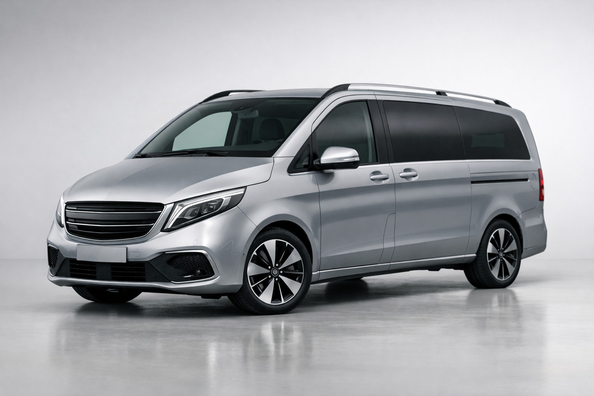
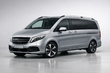
Mercedes-Benz EQV 300 is a large electric minivan for those who genuinely need space, quietness, and 6–8 seats—not just an EV with a premium badge. Its main strength is a comfortable cabin and logical behavior on urban and suburban routes; the main trade-offs are a heavy body, noticeable consumption on the highway, and charging that no longer looks like the fastest in the class.
In short, the EQV 300 is a great fit for hotel transfers, corporate shuttles, a large family, or regular trips from home or base along a predictable route. For constant long motorway runs, it’s no longer the kind of car that answers every question simply by being electric.
The EQV 300 sits in a narrow but clear segment: a premium electric minivan that combines the V-Class format with quiet city driving. It’s interesting on the market not for performance, but for offering lots of space, two sliding doors, easy access, and the feel of a truly large people-mover rather than an image statement. The model’s official positioning is a vehicle for family and business.
The EQV is at its best where passenger comfort, cabin quietness, and the ability to charge in one location matter most. If your priorities are frequent intercity trips, fast top-ups on the road, and less weather dependence, the model already looks like a compromise. Direct competitors are often cited as the Citroën ë-SpaceTourer, Peugeot e-Traveller, and Vauxhall Vivaro-e Life; pricier alternatives include the Tesla Model X and EQS SUV.
The production EQV has been on sale since 2020 and effectively exists within a single generation based on the W447 body, related to the V-Class. In 2024, the model received a noticeable update to the exterior, cockpit, and multimedia, but without a radical change to the battery or powertrain layout. In other words, the car’s logic stayed the same: maximum space and comfort, without promises of sportiness or long-distance capability.
For the EQV 300, engine displacement is irrelevant: it’s an EV, and in its current form it uses a single electric motor on the front axle. That’s why the choice of power versions is simple, but it’s important to look at range, real-world consumption, and charging speed.
| Parameter | What the EQV 300 has |
|---|---|
| Type | Electric minivan/van |
| Seating capacity | Depending on configuration, 6–8 seats; in some markets 7 seats is common |
| Powertrain | 1 electric motor, 150 kW (204 hp), 365 N·m |
| Drive and transmission | Front-wheel drive, single-speed reduction gear |
| Battery | 100 kWh gross capacity; about 90.0 kWh usable, in some markets 93.3 kWh is quoted |
| 0–100 km/h acceleration | 12.1 s |
| Top speed | 140 km/h |
| Range | WLTP around 357–364 km depending on market and how data is presented |
| Charging | AC 11 kW — about 10 h to 100%; DC 110 kW — 10–80% in roughly 40–45 min |
| Energy consumption | Officially around 27 kWh/100 km; noticeably higher on the highway and in winter |
| Dimensions | 5140 × 1928 × 1923 mm, wheelbase 3200 mm |
| Ground clearance | 106 mm |
| Trunk | 1030 L in normal condition, up to 4630 L with the rear row folded |
| Weight | Curb weight around 2811 kg, gross weight 3500 kg, payload up to 689 kg |
In practice, this means the following: the EQV 300 rides smoothly and evenly, but without a sense of lightness in reserve. For a large family or business minivan, 204 hp is enough, yet the vehicle’s weight constantly makes itself known under load, at higher speeds, and during braking.
| Official technical data | Value |
|---|---|
| Torque | 365 N·m |
| Drive type | Front |
| Battery architecture | 400-volt |
| AC charging power | 11.0 kW |
| DC charging power | 110.0 kW |
| Turning circle | 12.9 m |
| Permissible roof load | 150 kg |
| Number of sliding doors | 2 |
The EQV’s body is large even by minivan standards: over 5.1 m long, over 1.9 m wide without mirrors, and with a 3.2 m wheelbase. That’s great for interior space, but not so great for tight courtyards, underground parking, and maneuvering—the 12.9 m turning circle is noticeable. Plus, ground clearance is only 106 mm, so curbs, steep ramps, and winter ruts are not its favorite environment.
The suspension uses springs front and rear, with the setup focused on comfort. On good asphalt that’s a plus, but due to the body mass and standard chassis, the car doesn’t feel neatly tied down like a lighter vehicle. On the other hand, two sliding doors and a large cargo area make everyday logistics genuinely convenient.
The interior is one of the main reasons to look specifically at the EQV. Seating layouts vary by market and trim, but the point is the same: a spacious passenger compartment where you don’t have to fight for every centimeter in the second or third row. After the update, the model became more modern in the cockpit, and the comfort set can include a wide multimedia unit, pre-entry climate control, power seat adjustment, enhanced ambient lighting, and other options that really matter in daily use.
In terms of safety, the EQV doesn’t look bare either: there are modern braking assistants, lane keeping, blind-spot monitoring, adaptive cruise control, and a surround-view camera. The factory safety package includes emergency call, Active Brake Assist, DISTRONIC adaptive cruise control, Blind Spot Assist, Lane Keeping Assist, a 360° camera, and a center airbag. The weaker point is the ergonomics of some touch controls: it takes getting used to, especially if you want to adjust functions quickly while driving.
In the city and on calm suburban routes, the EQV 300 is pleasant: quiet, smooth, vibration-free, with a strong sense of premium passenger transport. If you have home or corporate charging, the car starts to look very logical: plug in at night, drive in the morning—no fuel stops and no stress over short daily mileage.
Problems start where the route is long, fast, and cold. On the motorway, consumption easily goes beyond 30 kWh per 100 km, and in winter the real range can drop noticeably. Add non-record fast charging, and it becomes clear why the EQV 300 isn’t the best choice for constant long trips. For frequent long-distance travel, a diesel V-Class is recommended sooner than an EQV.
From an owner’s perspective, the EQV 300 isn’t about all-round versatility—it’s about the right match between task and format. If your use case fits the car’s capabilities, it’s very pleasant. If not, the compromises become expensive and irritating fairly quickly.
| Plus | What it delivers in practice | Minus | What it means in real life |
|---|---|---|---|
| Very spacious cabin | Comfortable seating for family, transfers, child seats, and suitcases | High weight | Less ease in acceleration, braking, and maneuvers |
| Quiet at low speeds | Pleasant city driving without diesel noise | High highway consumption | On fast routes the range melts noticeably faster |
| Flexible seating layout | Easier to adapt the vehicle to business or family needs | Low ground clearance | You need to protect bumpers and the underbody on ramps and curbs |
| Premium equipment level | The vehicle doesn’t feel like a utilitarian van | Imperfect touch ergonomics | Some functions require getting used to |
| Convenience when charging at home or at base | Predictable daily operation | DC 110 kW is no longer impressive | On long trips, charging stops end up longer than you’d like |
For the EQV, it makes sense to focus not on show tuning, but on items that protect the interior, add capacity, and simplify daily use. Given the weight, aerodynamics, and low ground clearance, large decorative body kits are usually less appropriate here than practical accessories.
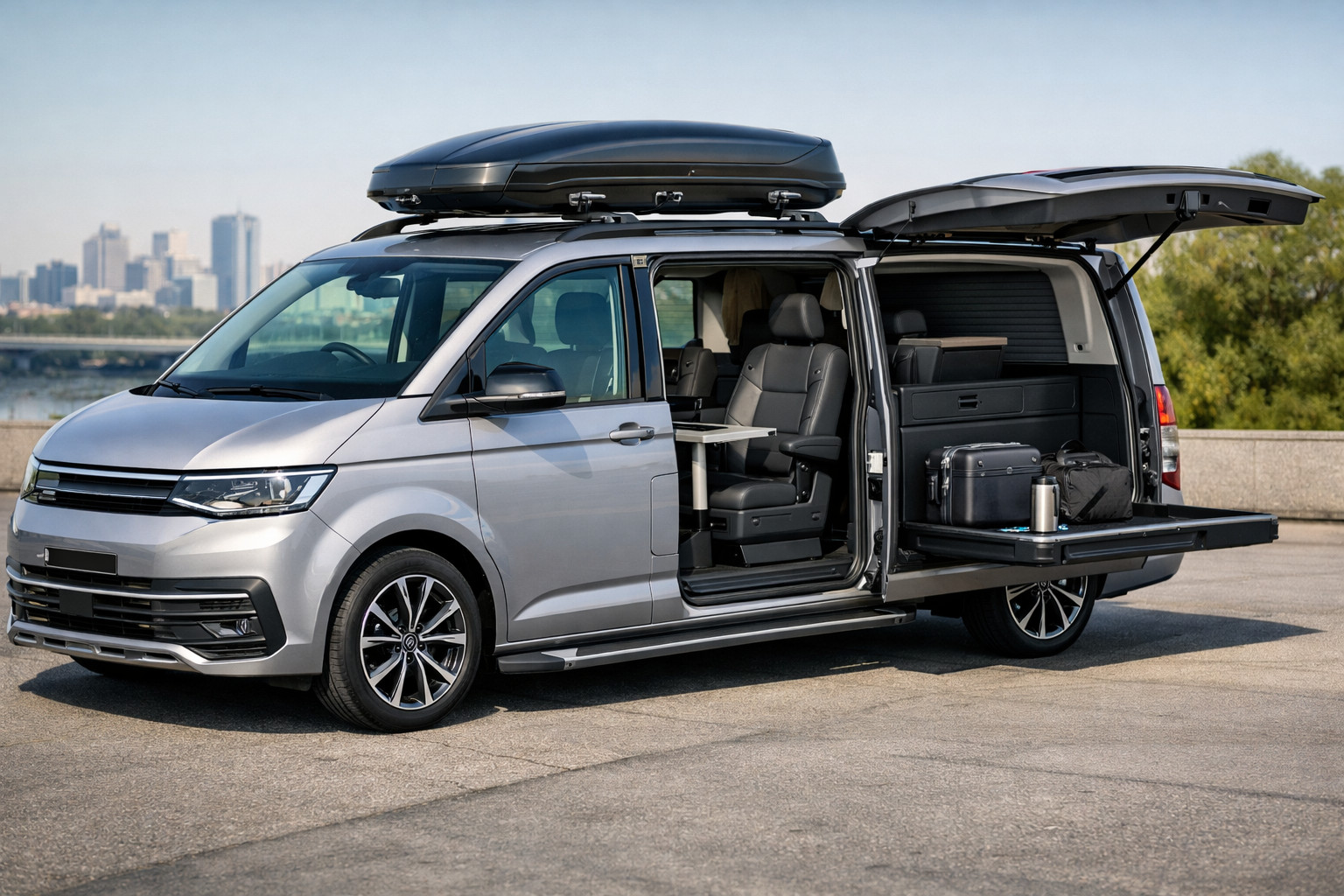
On the site, compatible solutions are best searched via the W447 base. If you need to quickly recheck the selection logic, return to this EQV 300 review; if your scenario is already clear, it’s best to start with the most commonly used items. It’s also useful to separately look at floor mats and roof cargo systems—these are exactly the kinds of products that best match the format of a large electric minivan.
Mercedes-Benz EQV 300 is a strong vehicle for a specific task: carrying people quietly, spaciously, and comfortably where the route is more or less predictable and there’s proper charging available. If you specifically need a large electric minivan for business or family use, it looks convincing; if you need a universal long-distance car without infrastructure caveats, it’s better to look for a different format.
| ✔ | A spacious cabin with 6–8 seats is well suited for family use, transfers, and trips with a lot of passengers and luggage. |
| ✔ | In the city and on calm routes, the EQV 300 drives quietly and smoothly, without diesel noise or vibrations. |
| ✔ | Two sliding doors and a large trunk make passenger access and everyday loading easier. |
| ✔ | After the update, the model got a more modern cockpit and multimedia section, as well as a rich set of comfort and safety options. |
| ✔ | Home or basic charging makes daily use predictable, especially if the routes are short and repetitive. |
| ✘ | The large mass noticeably affects the car’s feel: acceleration, braking, and maneuvering do not seem easy. |
| ✘ | On the highway, energy consumption rises significantly, which quickly reduces the driving range on fast routes. |
| ✘ | The ground clearance is only 106 mm, so curbs, steep ramps, and winter ruts require caution. |
| ✘ | DC 110 kW fast charging no longer seems especially fast for long trips, and in winter the range drops even more. |
Shipping to EU
Wholesale and retail
Own warehouse
Опис продукту
Подарунки не надаються при оформленні покупки у кредит під 0,01% або при покупці частинами.