22.06.2026
331
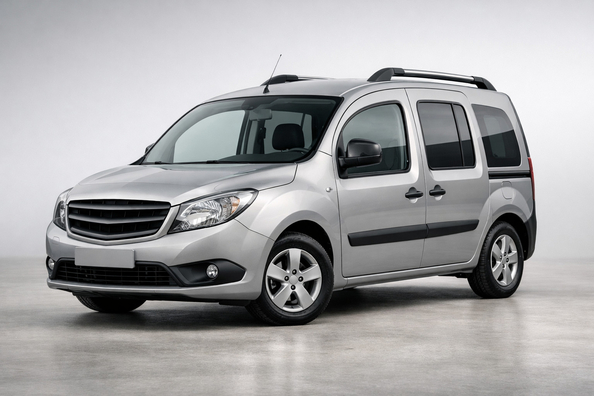
The first-generation Mercedes Citan W415 is a compact front-wheel-drive van that shows its strengths best in city work: it has small exterior dimensions, a good turning radius, frugal 1.5 L diesels, and a cargo bay that’s sufficient for deliveries, service calls, and small business. If you need a work vehicle for tight courtyards, parking by shops, and a daily short route, the Citan hits the mark.
But it’s important to understand the model correctly. This is not a passenger Mercedes in a van body, and not a replacement for larger vans. The cabin is utilitarian, safety on early cars wasn’t exemplary, and the range of engines and gearboxes depended on year and market. That’s why the Citan should be judged not by the badge, but by the specific body, engine, and work scenario.
The Mercedes Citan occupied the niche of a compact commercial vehicle between passenger cars and larger vans. Its direct rivals are the Renault Kangoo, Volkswagen Caddy, Ford Transit Connect, Citroen Berlingo, Peugeot Partner, Fiat Doblo, and Nissan NV200. The main idea is simple: give business a compact van with city maneuverability, but with more tightly tuned chassis settings than related mass-market models.
The Citan is best suited to courier delivery, mobile tradespeople, small sales teams, and anyone who drives around town with frequent stops. It makes less sense for those who expect the cabin feel of a passenger Mercedes or who often carry heavy loads over long highway runs.
This review covers 2013–2021, but the first-generation W415 actually launched back in 2012. Essentially, the entire period up to the generation change is one model with different bodies, lengths, and a powertrain lineup updated for certain markets. Technically, the Citan is closely related to the Renault Kangoo, but Mercedes reworked parts of the electrics, suspension, and overall driving behavior tuning.
For the first Citan, the range included a cargo panel van, mixed cargo-passenger versions Mixto and Crew Van, and passenger versions Combi and Tourer. Depending on the version, body length was 3940, 4320, or 4710 mm, so the model covered both the role of a short city van and that of a compact family-work vehicle.
With engines, it’s important not to overgeneralize: the lineup changed depending on year and market. At launch there were three 1.5 L diesels and a 1.2 L petrol, while in later markets some versions remained only with 109 CDI and 111 CDI. In all cases, it’s front-wheel drive.
| Version | Engine | Power | Torque | Transmission |
|---|---|---|---|---|
| 108 CDI | 1.5 L diesel | 75 hp | 180 N·m | 5-speed manual |
| 109 CDI | 1.5 L diesel | 90 hp | 200 N·m | 5-speed manual, in some later markets 6-speed |
| 111 CDI | 1.5 L diesel | 110 hp | 240 N·m | 6-speed manual |
| 112 | 1.2 L petrol | 114 hp | 190 N·m | 6-speed manual |
If you look at the Citan as a work tool, the 109 CDI is usually enough for the city and moderate loads, while the 111 CDI is noticeably better where there’s highway driving, постоян load, or a passenger version. The 108 CDI only makes sense for calm urban use with no big demand for pulling power. The petrol 112 is rarer and needs a separate assessment based on mileage and service history.
The Citan’s strong point is the wide choice of bodies and sizes. In the city this matters: you can pick a short body if parking and maneuverability are the priority, or a longer one if cargo volume is key. The suspension is tuned firmer than on the related Kangoo, so the vehicle feels more composed, especially at speed and during lane changes.
| Parameter | Value |
|---|---|
| Body length | 3940, 4320 or 4710 mm |
| Van dimensions L2 | 4321 × 1829 × 1816 mm |
| Van dimensions L3 | 4705 × 1829 × 1839 mm |
| Width with mirrors | 2138 mm |
| Wheelbase | 2313, 2697 or 3081 mm |
| Ground clearance | 148 or 153 mm |
| Turning circle | 10,13, 11,23 or 12,43 m |
| Van cargo volume | 2,4, 3,1 or 3,8 m³ |
| Cargo bay length | 1369, 1753 or 2137 mm |
| Bay width / between wheel arches | 1460 mm / 1219 mm |
| Bay height | 1258 mm |
| Luggage volume (passenger versions) | up to 3,0 m³ depending on configuration |
| Payload | approximately 490–810 kg |
| Braked towing capacity | up to 1050 kg |
| Roof load | 100 kg |
| Fuel tank | 60 L |
In practice, it means one simple thing: short versions are more convenient for a dense city pace, while L2 and L3 already provide noticeably more usable cargo space without moving up to a larger class. The ground clearance isn’t off-road grade, so curbs, construction sites, and rough rural roads aren’t its favorite scenario.
The interior in the first Citan is simple and quite hard to the touch. That’s not a tragedy for a commercial vehicle, but it’s better to drop inflated expectations right away: everything here is about function, not a premium feel. On some vehicles, even air conditioning and radio were not standard, so equipment needs to be checked separately.
In terms of comfort, the Citan is considered quieter and more composed than the base Kangoo, but it’s still far from passenger-car levels. Safety is also uneven: early vehicles felt weaker, while after improvements the Euro NCAP rating for the Kombi rose to 4 stars. The basic set of systems included stability control, ABS, brake force distribution, emergency brake assist, and hill-start assist; depending on the version, there were front, side, and curtain airbags.
In daily life, the Citan is strong where the van is constantly working in the city. Maneuverability, compact width, and a small turning radius really save time at every stop. The 1.5 L diesels in a calm mode don’t blow the fuel budget, although real-world consumption is usually higher than the brochure figures: in tests the 109 CDI showed about 5.5 L/100 km, which is still fine for the class.
Officially, long service intervals were stated for the model—up to 40,000 km or 2 years—but for a used commercial vehicle it’s better to base decisions not on the maximum from the brochure, but on the real operating mode and service history. During inspection it’s especially important to check diesel starting, starter operation, clutch condition, the air conditioner, and electrics. These are exactly the areas that most often spoil the impression of a vehicle that looks very good on paper.
As a work tool, the Citan is also convenient because it allows different scenarios: a van for delivery, a passenger version for small transfers, a mixed format for installers or a service crew. If you need a higher durability reserve for постоян overloading or more confident highway stability, it’s worth looking toward larger and heavier models.
| What to evaluate | Pros | Cons |
|---|---|---|
| City work | Compact body, small turning radius, easy to park and maneuver in courtyards | On the highway with a load it doesn’t inspire the same confidence reserve as larger competitors |
| Cargo capability | Good bay volume for the class, several body lengths, payload up to 810 kg | Not a segment record-holder for payload and not a replacement for a mid-size van |
| Costs | 1.5 L diesels are economical, the 60 L tank is convenient for work without frequent refueling | Real-world consumption is higher than official figures, especially on heavier and passenger versions |
| Comfort | Suspension and sound insulation are better than you’d expect from the related base | Simple interior, sparse equipment on some vehicles |
| Used market | Many bodies and variants, easy to choose for a specific task | Condition heavily depends on previous use; you need to carefully check the clutch, starting, electrics, and air conditioning |
| Safety | Basic active safety systems are present, later improved vehicles look better | Early vehicles made a weaker impression in test results |
From an owner’s perspective, the picture is simple: the Citan is выгодний when it works every day and earns its keep with maneuverability, compactness, and moderate consumption. If the main criteria are rich equipment, passenger-car quietness, or maximum cargo durability, it will quickly show its limits.
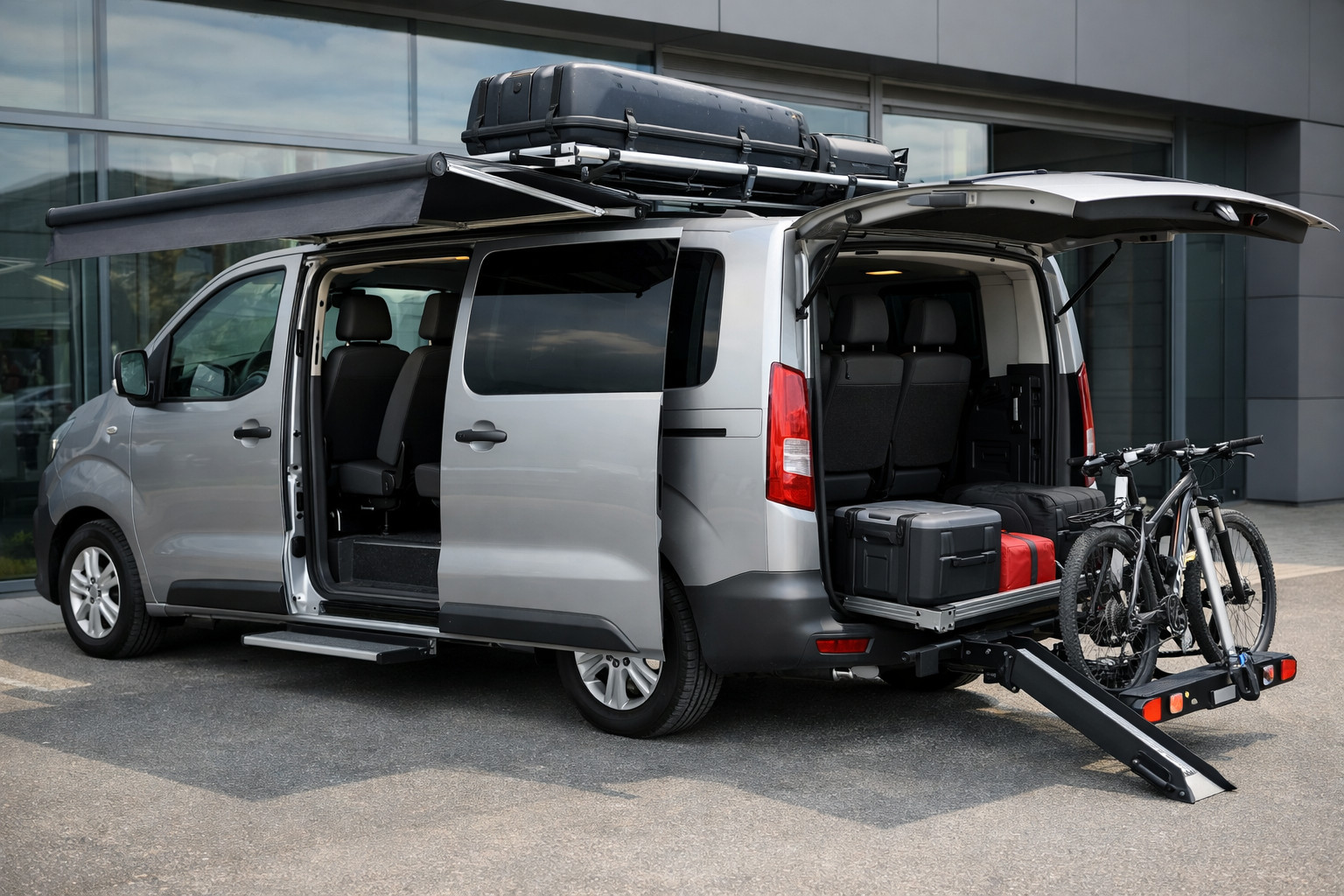
For the Citan, tuning makes sense when it solves everyday tasks rather than just adding decoration. On the Mercedes Citan 2013-2021 page, it’s logical to start with things that genuinely make work easier: protecting the interior from dirt, organizing tool transport, and preserving the body during daily loading.
After that, it makes sense to look at a rear bumper protector, mud flaps, seat covers, and simple interior extras. For the Citan, the smartest approach is not to “dress up” the vehicle, but to equip it for a specific job: delivery, service calls, installation work, or a mixed family-and-work routine.
The Mercedes Citan W415 is a solid choice for those who need a compact city van with decent economy, several body formats, and sufficient cargo potential without moving up to a larger class. It fits best for businesses with a dense urban cycle, and least of all for those who expect passenger-car comfort or the durability reserve of a large van.
When buying, what matters is not the badge or the year in the registration, but the specific version, equipment, clutch and electrics condition, and service history. This material is based on real selection experience, practice, and real usage scenarios, so the main conclusion is simple: a properly chosen Citan is truly convenient in the city and for work—but only when it’s bought for a specific task, not “just because it’s a Mercedes.”
| ✔ | Compact dimensions, a tight turning radius, and easy parking make the Citan very practical for dense city traffic, courtyards, and frequent stops. |
| ✔ | The 1.5-liter diesel engines are economical, and the 60 l tank is convenient for work trips without frequent refueling. |
| ✔ | There are several body and length options, so the model can be suited to deliveries, service calls, or a mixed passenger-cargo format. |
| ✔ | For its class, the Citan has a decent cargo area and a payload of about 810 kg, which is enough for small business. |
| ✔ | The suspension and handling are more composed than in the related Kangoo, so the vehicle feels more confident on the road. |
| ✘ | The cabin is simple and utilitarian, and on some cars even basic equipment such as air conditioning or a radio could be missing. |
| ✘ | Early cars gave a weaker impression in terms of safety, so when buying it is important to look at the year and the specific trim. |
| ✘ | Under load and on the highway, the Citan does not offer the same reserve as larger vans, so it is not suitable as a replacement for a mid-size van. |
| ✘ | Real-world fuel consumption is higher than the official figure, especially on heavier and passenger versions. |
| ✘ | The condition of used cars depends heavily on previous use, so it is necessary to carefully check diesel starting, the clutch, electrics, and air conditioning. |
Shipping to EU
Wholesale and retail
Own warehouse
Опис продукту
Подарунки не надаються при оформленні покупки у кредит під 0,01% або при покупці частинами.