03.05.2026
495
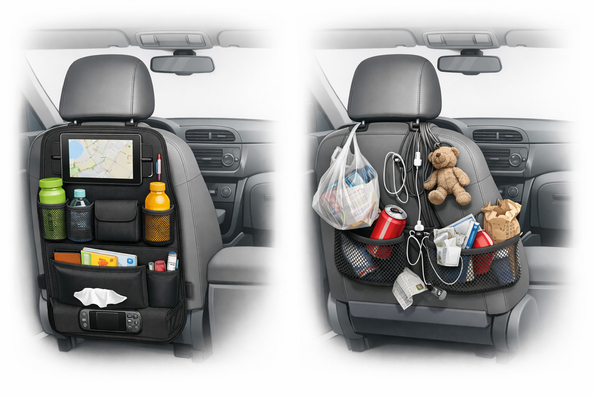
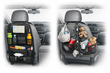
A seat-back organizer is useful not by itself, but only when it removes recurring clutter from the cabin and gives rear passengers quick access to the small items they need. If almost no one rides in the back, it often turns into a hanging stash of wipes, receipts, cables, and random stuff that only takes up space and gets on your nerves.
The second part of the issue is safety and ergonomics. A sagging organizer steals legroom, and unsecured or heavy items in the cabin can become unwanted projectiles under hard braking. So you shouldn’t judge the accessory itself—you should judge the scenario: who rides in the back, what exactly needs to be kept within reach, and whether the seat design allows it.
Most often, people buy an organizer as a universal fix for clutter, even though it solves a fairly narrow task: storing a limited set of light items within reach of the rear row. When expectations are different—hide everything extra, replace a trash bin, protect the seatback from dirt, and also give a child a place to eat—disappointment starts.
The problem is made worse by differences between cars. In compact models, rear legroom is limited, and a large soft organizer quickly starts to sag. On family trips it can be genuinely convenient, but in a car used for daily short drives by one driver, this thing often hangs there without a system and without any benefit.
DD Tuning expert comment: the most common mistake is buying a wide soft organizer and immediately filling every pocket. When choosing, thin models with proper tension at two points and a short list of items inside work better. If the accessory already sits poorly when empty, it won’t get better after loading.
| Symptom | Likely cause | What to do |
|---|---|---|
| The bottom of the organizer hits knees or legs | Oversized format or loosely tightened straps | Try a shorter, thinner model or avoid this format for a small cabin |
| Pockets are full, but you still can’t find what you need | No fixed set of items | Keep only what’s needed on every trip; move the rest to the glovebox or trunk |
| The organizer quickly becomes crooked | Incompatible seat/headrest or poor mounting | Check tension at the top and bottom; if you can’t get it tight, don’t force the accessory |
| A child kicks or snags the organizer with their feet | It hangs too low or is overloaded | Stop using the lower pockets, keep only flat and light items, or choose a different organization method |
| After a week, some items just sit there unused | The rear row is used rarely | Remove the organizer and switch to a portable bag or basic in-cabin sorting |
If children or passengers regularly ride in the back and you need to keep a few light items within reach, it makes sense to look specifically at seat-back organizers. They’re appropriate when there’s a real access scenario, not just the desire to “put something somewhere.”
When the main problem is dirt from shoes, upholstery scuffing, or marks from kids’ feet, sometimes seat covers make more sense. And if the mess starts with sand, water, small debris, and everything that falls down, rubber floor mats help faster than extra pockets on the seatback.
| Solution | When it works | When it’s not worth spending money |
|---|---|---|
| Thin seat-back organizer | Frequent trips with rear passengers; you need access to 4–6 light items | The rear row is almost always empty or the cabin is very tight |
| A separate place for trash | Wrappers, wipes, and receipts constantly accumulate in the pockets | If the issue isn’t trash, but lack of access to needed items |
| Travel tray for a child | You need to eat, draw, keep toys in front of you | If you only need to store wipes, water, or cables |
| Portable bag or center organizer | The seat won’t allow proper strap tension or there’s a rear-facing child seat | When you need quick access specifically from the back of the front seat |
| Skip the organizer and do regular cabin decluttering | The car is used mostly by one driver on short routes | When the car truly lives on family trips and items are constantly needed in the back |
From a customer’s experience: in a family crossover, they wanted a way to clear wipes, a cable, and kids’ books off the floor. After trying a large soft organizer, they replaced it with a thinner model, removed everything unnecessary from the pockets, and moved trash to a separate container. The result was tidiness without sagging and without the constant feeling that there’s yet another unnecessary thing hanging on the seatback.
A seat-back organizer works when it serves a specific scenario: regular trips with rear passengers, a short list of light items, and proper mounting without sagging. But if the rear row is hardly used, the cabin is tight, or the accessory is stuffed with everything, it very quickly becomes junk rather than a helper.
This material is based on real selection experience, hands-on practice, and real usage scenarios: in most cases, the win isn’t the purchase itself, but a sober choice of format, correct mounting, and cutting out unnecessary items in the cabin.
| ✔ | Useful when passengers regularly ride in the back and you need to keep a few lightweight items within reach, rather than all the little cabin clutter. In that scenario, it really clears up recurring mess and saves time looking for tissues, a cable, or a book. |
| ✔ | If the model is thin and fits properly under tension at two points, it sags less and does not get in the way of the legs as much. This is especially important in a small cabin, where every centimeter of space matters. |
| ✔ | The organizer helps keep in order items that often lie around without a system: tissues, receipts, small toys, a small bottle of water. When the set of items is limited in advance, access to them becomes truly convenient. |
| ✔ | For family trips, it can be a practical way to keep the rear row more organized. This works especially well when rear passengers use it constantly rather than only occasionally. |
| ✘ | In a cramped cabin or with an organizer that is too bulky and soft, it starts to hang down and interfere with the knees and legs. If rear space is already limited, the accessory takes up more than it gives. |
| ✘ | Weak mounting quickly makes it inconvenient: the organizer tilts, sways, and no longer holds items properly. In this state, it looks like a temporary solution rather than real organization. |
| ✘ | If everything gets stuffed into the pocket, the main advantage disappears — quick access to what you need. Then it turns into a storage spot for random small things, where nothing can be found. |
| ✘ | For children, there is a risk that the lower pockets will press against their legs or that access to them will become unsafe because of hard objects. In other words, the accessory needs to be chosen very carefully for a specific seat and the passengers' age. |
Shipping to EU
Wholesale and retail
Own warehouse
Опис продукту
Подарунки не надаються при оформленні покупки у кредит під 0,01% або при покупці частинами.