26.08.2026
158
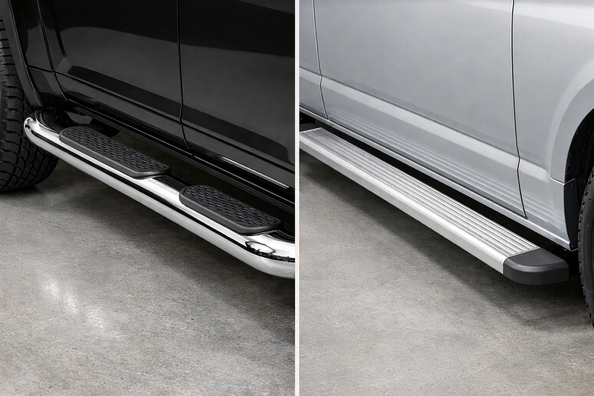
If running boards are needed for everyday use on a crossover, a large SUV, or a van, in most cases it’s more practical to choose aluminum. It’s lighter, handles winter, road chemicals, and frequent washes more calmly, and a proper non-slip surface matters more than shine.
A chrome-plated option is worth considering when appearance really is your priority. But there’s a nuance: in this niche, “chrome” often doesn’t mean a separate metal, but a coating on different bases, so you should compare not only color and gloss, but also installation, step width, noise, service life, and maintenance.
The difference between chrome and aluminum running boards in real-world use comes down to two things: how they cope with a climate with moisture and salt, and how convenient they are day to day. For a van and a tall family vehicle, the winner is usually not the option that looks brighter, but the one with a wider platform, proper tread, and precise mounting without play.
So the choice is simple: if you want to install them and not think about the finish for a long time, look toward aluminum or an aluminum platform with a quality top pad. If your vehicle already has a chrome package and it’s important to keep the factory look, a chrome-plated set can make sense, but it will require more careful maintenance and a more selective choice of manufacturer.
| Option | Strengths | Weaknesses | Who it suits |
|---|---|---|---|
| Chrome running boards | Bright look, pair well with a chrome package, visually add a “factory” accent | Quality heavily depends on the coating and base; in winter and on salt, cheaper versions lose their appearance faster; the shine requires upkeep | Those who prioritize looks and are willing to accept more demanding care |
| Aluminum running boards | Lighter weight, good corrosion resistance, practical for daily use, more stable behavior in winter | Don’t deliver such pronounced shine; polished aluminum also needs regular care | Those who need a functional, comfortable, and less finicky option for city driving, highways, travel, and commercial use |
DD Tuning expert comment: The most common mistake is buying running boards “by the photo” without understanding what “chrome” actually means and how the kit mounts to a specific body. For a van, length and the number of supports are critical, and for a daily driver, the platform must not be slippery and shouldn’t stick out too far. If noise appears after installation, check the brackets and torque first rather than blaming the material.
Chrome’s strong point is obvious: it looks more premium and pairs best with vehicles that have bright trim, a chrome grille, or classic body styling. For an executive van or a large SUV, it can be a very fitting solution if the vehicle is driven mostly in the city and stored without constant exposure to dirt and road chemicals.
The weak spot of chrome options is that the same word can be used to sell very different constructions. If the coating is weak or the edges are poorly protected, that’s where blistering, peeling, and small defects appear first. Another point: a nice shine doesn’t compensate for a narrow or slippery step, so for a family vehicle or a van, looks shouldn’t be the main argument.
Aluminum running boards are usually made from an extruded profile, and that’s often what provides a good balance of weight, rigidity, and service life. For winter, they make more sense: aluminum doesn’t rust, and quality powder-coated or mixed designs tolerate moisture, salt, and frequent washes better.
In practice, aluminum also wins because many models offer comfortable wide platforms. For a large vehicle or a van, this matters: a proper support area, non-slip tread, and adequate load rating are felt every day. The only nuance is that if you choose polished aluminum for the shine, it also doesn’t like neglect and will need polishing from time to time.
| Criterion | Chrome-plated | Aluminum |
|---|---|---|
| Installation | Depends on the specific kit; often uses factory brackets without drilling | Usually also uses factory mounting points; more convenient in practical kits |
| Noise | The material itself isn’t the cause, but play and poor mounting can create squeaks | Likewise depends on brackets and installation quality, not the aluminum itself |
| Service life | Highly dependent on the coating; in winter cheaper options deteriorate faster | Handles salt and moisture better, especially with a quality coating |
| Practicality | Works well as a styling element, but not always the most convenient everyday option | Better for daily use, families, travel, and commercial work |
| Total cost of ownership | May require more upkeep and lose its appearance sooner | Often more cost-effective in the long run |
For a city crossover or a large family vehicle, the better choice is usually aluminum with a tight fit to the body and a proper top insert. These running boards are less stressful in everyday life: easier to care for, less worry about the finish after winter, and easier to keep looking neat.
For a passenger van or shuttle, what matters is not so much the material and shine as platform width and stable footing when boarding. Here an aluminum platform is almost always more appropriate than a chrome accent, especially if the vehicle carries a family, children, or passengers every day.
A chrome option makes sense where the vehicle is built around a specific image: a show vehicle or a well-kept road van, an SUV with a chrome package, or a vehicle without harsh winter use. So it’s not a bad choice—it’s just less universal.
| Scenario | What to choose | Why |
|---|---|---|
| Daily city vehicle | Aluminum running boards | Easier to live with in winter, easier to wash, lower risk of losing appearance |
| Winter use with road chemicals | Aluminum with a quality top surface | Handles salt and moisture better, fewer chances of coating issues |
| Passenger van | Wide aluminum platform | More convenient for boarding, especially for children, elderly people, or passengers with luggage |
| Commercial van | Practical aluminum kit for the specific body | Service life, rigidity, and compatibility matter more than decorative shine |
| Vehicle with a chrome package and careful use | Chrome running boards | Best visual match to the body style if you’re ready for the upkeep |
A pricier kit is justified not when it simply shines more, but when you get a better design: precise vehicle-specific brackets, a tighter fit to the body, a wider platform, neat end caps, and proper tread. For a large SUV, that brings daily convenience; for a van, less fatigue from boarding and exiting.
If you want to compare formats without being tied to one design, start with the running boards tuning section. For classic solutions, it’s worth separately looking at side steps, and for a passenger or service van it can sometimes be more logical not to overpay for a long decorative set, but to choose a separate sliding door step if that’s where the main load is.
In other words, the extra cost makes sense for function and compatibility, not for the name of the finish itself. If the choice is between a mid-range chrome kit and a quality aluminum platform with good mounting, real life usually favors the second option.
From a customer’s experience: for a passenger van, they initially looked for a chrome kit because they wanted a “more upscale” look. After подбор, it turned out that daily boarding for kids and parents required a wider, less slippery platform, so they chose an aluminum option. In the end they were satisfied specifically with the convenience: less stress in winter, and the appearance stayed neat without extra care.
In short, for most crossovers, large SUVs, and vans it’s more practical to choose aluminum running boards. They’re better suited to everyday use, handle winter and road chemicals more calmly, and disappoint less often after a few seasons.
Chrome makes sense when you consciously put appearance above low-maintenance practicality and are ready to pay closer attention to the finish. The main advice is simple: look at installation, step width, and slipperiness first—and only then at the shine.
| ✔ | Aluminum side steps are better suited for everyday use because they are lighter and handle winter, road chemicals, and frequent washing more calmly. This is a practical option for a crossover, SUV, or van. |
| ✔ | For a van and a large family vehicle, a wide platform with a non-slip surface is important, and in the article it is aluminum kits that more often provide this format. It is more convenient for children, elderly people, and passengers with luggage to get in. |
| ✔ | Aluminum handles salt and moisture better, especially if it has a quality coating. Because of this, it is less likely to lose its appearance after several winters. |
| ✔ | Chrome side steps suit cars with a chrome package well and can preserve the factory-style look of the body. If appearance really matters, this is a suitable option. |
| ✔ | The article emphasizes that durability and comfort depend more on the installation, step width, and mounting than on the material itself. This helps you choose not by photos, but by real parameters. |
| ✘ | Chrome side steps depend more heavily on the quality of the coating and base: in cheaper versions, defects, blistering, and peeling appear faster in winter. So the shine can quickly lose its look. |
| ✘ | Chrome requires more careful care, because its good appearance has to be maintained regularly. For a daily car, this adds extra hassle. |
| ✘ | With chrome sets, looks do not guarantee convenience: if the step is narrow or slippery, that is a problem for a family car or a van. In that case, the decorative look does not compensate for the inconvenience. |
| ✘ | Polished aluminum is not completely low-maintenance either and needs polishing from time to time. If you need shine specifically, care will still be required. |
Shipping to EU
Wholesale and retail
Own warehouse
Опис продукту
Подарунки не надаються при оформленні покупки у кредит під 0,01% або при покупці частинами.