18.08.2026
151
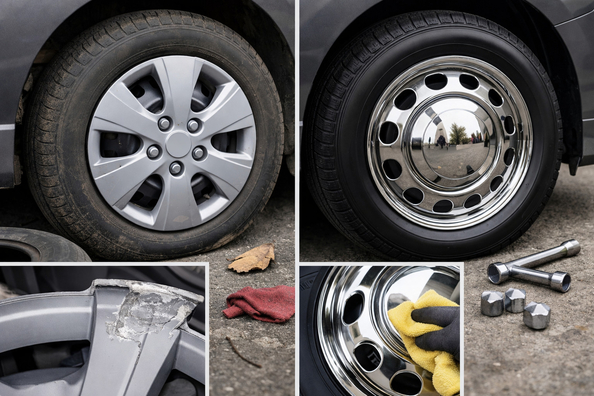
For everyday driving, what matters isn’t the shine of the material, but how the hubcap sits on the steel wheel: whether it rattles, whether it flies off in potholes, and how much a replacement costs. In most passenger-car scenarios, ABS plastic turns out to be more practical: it’s lighter, usually cheaper, and handles salt, road chemicals, and ordinary impacts from small debris just fine.
Stainless steel has its place, but not as an automatically “better” option. It’s significantly heavier, stiffer, and more demanding about an exact fit, but it keeps a tidy look longer and is easier to wash and polish. So the choice here isn’t simply cheap vs expensive—it’s everyday practicality vs longer-lasting appearance.
Put in one sentence: for daily city and highway driving, quality ABS plastic more often wins, while stainless steel makes sense where long-lasting looks, easy care, and harsher use matter more.
The difference starts with weight. With the same volume, stainless steel is about 7.5 times heavier than ABS, so it demands stronger, more reliable retention. On rough roads, a lighter hubcap is usually easier to keep in place without rattling or popping on bumps—provided it’s correctly matched to the wheel.
The second key point is compatibility. The same diameter doesn’t mean a hubcap will fit correctly: the shape of the wheel lip, the retention design, the spring ring or clips, and sometimes even the geometry around the lug nuts all matter. That’s why the material alone won’t save you from noise or losing a hubcap.
| Option | Strengths | Weaknesses | Best for |
|---|---|---|---|
| ABS plastic | Low weight, lower price, good resistance to salt and chemicals, easier to live with in everyday driving | Cheap sets may crack, squeak, and lose retention; appearance depends more heavily on coating quality | City, highway, family car, daily use without extra expense |
| Stainless steel | Keeps its shine longer, easier to wash, stiffer and stronger as a material | Heavier, more expensive, more sensitive to imperfect fit and weak clips | Commercial vehicles, harsh duty, anyone who values a well-kept look of steel wheels |
DD Tuning expert comment: most mistakes aren’t about the material, but about choosing the right fit. People buy a universal set by diameter only, install it on a dirty or cold wheel, and then blame the noise on “bad plastic” or “heavy metal.” If the fit is tight, the clips are intact, and the wheel lip is compatible, even a simpler option works quietly in daily driving and without surprises.
The strong point of ABS is the balance of weight, price, and practicality. For a decorative hubcap this is crucial: the lower the mass, the less load on the clips and the lower the risk the hubcap starts moving on potholes. That’s why plastic has long been the baseline solution for passenger cars.
But not all plastic is the same. Thickness, rib stiffness, coating quality, and the spring ring matter far more than the mere fact it’s ABS. A good set lasts for years, while an overly cheap universal option can start cracking, lose its shine, or loosen up in the very first season.
Care matters when installing plastic hubcaps: a clean wheel, the correct ring position, and preferably warmer weather, when the material is a bit more elastic. If you install the set on a dirty lip or don’t fully seat the clips, you get exactly the noise that often causes people to underestimate plastic.
Stainless hubcaps are chosen not so much for “on-paper” strength as for looks and care. They keep a neat shine longer, clean up more easily after dirt, and are useful where people want to repaint steel wheels less often or keep them looking decent all the time.
The downside is that higher stiffness and weight don’t forgive sloppy installation. If the fit isn’t ideal, a metal hubcap won’t necessarily be quieter or more secure than a plastic one. On the contrary: due to the weight, weak clips or a poorly chosen universal size will reveal the problem sooner.
So stainless steel wins where there is either precise compatibility or a better mounting system—and where long-term appearance truly matters. For a typical passenger car, it doesn’t always deliver practical value proportional to the extra cost.
For regular city driving, highway trips, daily commutes, and parking near curbs, the smartest choice is quality ABS plastic without aggressive décor. It’s cheaper to live with when it comes to everyday scratches, doesn’t overload the mounting points, and doesn’t make you pay extra just for shine.
If the car is often used for deliveries, racks up high mileage, is washed regularly, and wheel appearance matters every day, then stainless steel becomes the more logical choice. Especially on commercial vehicles, where a well-kept look and easy cleaning matter, and the slightly higher weight isn’t as critical as it is in passenger-car use with potholes and frequent suspension impacts.
For winter, both materials are suitable—but again, the deciding factor isn’t the name of the material, it’s product quality. ABS handles salt and chemicals well, and stainless steel doesn’t fear corrosion, but any set will lose if installed on an incompatible wheel or with worn clips.
| Scenario | Best choice | Why |
|---|---|---|
| Daily city driving | Quality ABS plastic | Lighter, cheaper, sufficiently resistant to salt and normal road loads |
| Highway + bad roads | Quality ABS plastic with a tight fit | Lower mass puts less stress on the clips, meaning a lower risk of noise and losing the hubcap |
| Commercial vehicle or minibus | Stainless steel | Easier care, stays neat longer under intensive use |
| Ultra-budget replacement | ABS plastic, but not the thinnest universal set | Lowest cost, but you need to pay close attention to ring and clip quality |
| Priority: looks and shine | Stainless steel | Holds the visual effect better and is easier to polish |
| Winter, salt, frequent washing | Both are possible; fit quality has the edge | Material matters, but compatibility with the wheel and mounting condition decide |
Paying extra is justified when the hubcaps aren’t just meant to cover a steel wheel, but to keep a neat look for a long time without constant touch-ups—especially on vehicles with high mileage or frequent washes. If you need a calm everyday option without extra expense, it makes sense to look first at plastic hubcaps.
Stainless steel is appropriate where ease of care and visual longevity are the priorities. For that scenario, it’s worth checking stainless steel hubcaps separately, and if you want to quickly review the basic criteria before buying, it’s handy to keep this hubcap selection guide close at hand.
From a customer’s experience: for a daily passenger car, the person initially looked for stainless steel because of the shine, but after checking compatibility and operating conditions, chose a quality ABS set with a tight fit. In the end, the deciding factors were quietness over bumps, lower replacement cost, and no need to constantly adjust the clips. Stainless steel was kept as an option for the second, more work-focused vehicle, where wheel appearance and easy washing matter more than weight.
For everyday driving, what’s best is often not the “strongest,” but the most appropriate option. In most cases that’s quality ABS plastic: it’s lighter, more affordable, and practical enough for the city, highway, winter, and a normal driving routine.
Stainless steel makes sense when you consciously pay extra for longer-lasting appearance, easier care, and a neater look for steel wheels under demanding use. The main thing is not to reduce the choice to material alone: proper fit, compatibility, and mounting quality matter more. This conclusion is based on real-world selection experience, practical know-how, and real usage scenarios—not just dry material specs.
| ✔ | ABS plastic is lighter, so it puts less strain on the clips and usually stays in place better on rough roads without rattling. For daily driving, this reduces the risk of noise and the hubcap coming loose. |
| ✔ | Plastic hubcaps are usually cheaper, so replacing them is easier on the budget. This is practical for city driving, highways, and everyday use, where hubcaps are more likely to get minor damage. |
| ✔ | ABS handles salt, road chemicals, and normal driving loads well. In winter, this makes it a safe and predictable option for a passenger car. |
| ✔ | Stainless steel keeps a neat look for longer and is easier to clean after dirt. If the car is washed often or a tidy wheel appearance matters, this is a real advantage. |
| ✔ | For commercial vehicles, stainless steel hubcaps look more appropriate because their appearance is easier to maintain under heavy use. Here, their rigidity and low-maintenance nature can be more useful than minimal weight. |
| ✘ | Stainless steel is much heavier than ABS, so it has higher requirements for precise fit and secure fastening. On poor roads, this can result in noise or weaker retention. |
| ✘ | Cheap universal plastic can crack, loosen, or start squeaking after just one season. In other words, the savings only work when the set is truly high quality. |
| ✘ | The material itself does not solve the problem of noise or losing the hubcap. If the rim is dirty, the lip is incompatible, or the clips are weak, problems will happen with both plastic and stainless steel. |
| ✘ | Stainless steel is more expensive, and this extra cost is not always justified for ordinary everyday passenger driving. If the priority is quietness, replacement cost, and simplicity, the practical benefit may be too small. |
Shipping to EU
Wholesale and retail
Own warehouse
Опис продукту
Подарунки не надаються при оформленні покупки у кредит під 0,01% або при покупці частинами.