23.09.2026
80
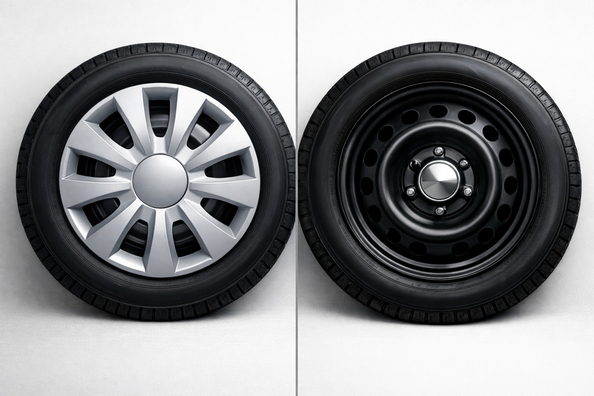
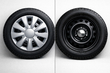
If you need a practical option for steel wheels, then in most everyday scenarios center caps win: they’re cheaper, quieter, and don’t complicate washing or inspecting the wheel. Full wheel covers make sense when the main goal is to hide the plain or tired look of a steel wheel and get a neater-looking wheel without switching to alloy rims.
The confusion comes from the names themselves. In this article, “wheel covers” means full overlays for a steel wheel, while “caps” means center plugs that cover only the hub area. These are different in function, installation, and on-road behavior, so you should choose them not by the picture, but by the operating conditions.
A full wheel cover hides almost the entire front face of the wheel. It’s chosen mostly for looks: to hide a basic stamped wheel, cover corrosion marks, and make a winter set look less utilitarian. An extra bonus may be possible on the highway if the design is more closed, but that’s not the main reason people buy them.
A center cap covers only the hub and fastener area. It doesn’t turn a steel wheel into a decorative element, but it gives what many people actually need: a covered center, less exposed dirt in that area, easy access to the wheel, and fewer chances of hearing rattles after hitting a pothole.
So the choice comes down to priority: either you disguise the entire wheel, or you keep the setup as simple and practical as possible.
| Option | Strengths | Weaknesses | Who it suits |
|---|---|---|---|
| Full wheel covers | Significantly change the look of the wheel, hide rust and plain stamped steel, sometimes give a small benefit on the highway | Demanding in terms of compatibility, can be noisy, loosen up, fly off in potholes, make washing and inspection harder | Those who care how their winter or budget wheel set looks |
| Center caps | Cheaper, easier to match after accurate measurement, don’t block access to the wheel, easier to maintain | Barely hide the wheel itself, modest decorative effect, can also rattle if the clips are weak | Those who want a practical solution without extra parts on a steel wheel |
DD Tuning expert comment: the most common mistake is buying wheel covers by diameter only, without checking the shape of the stamped wheel, the valve stem, and the ring fit. The second typical story is installing wheel covers on a winter set and ignoring the first rattle after potholes: once play appears, the part will either rub through the coating or fly off. For center caps, what matters isn’t the logo, but the exact fit size.
Full wheel covers. This is a looks-driven solution. It’s appropriate when the steel wheel itself annoys you, has old paint marks or surface rust, and you don’t plan to change the wheel set. But this is also where compatibility fails most often: you need the correct diameter, the right cutout for the valve stem, and proper clamping. After installation, the cover shouldn’t come off too easily by hand.
In practice, the weak point of wheel covers isn’t the plastic itself, but the fit. If the wheel is slightly deformed, the valve stem sits awkwardly, or the retaining ring is weak, noise appears. On bad roads there’s another risk: the cover can shift, catch the tire sidewall edge, or simply get lost after an impact.
Center caps. They cover only the center and don’t promise more than they can actually deliver. If the task is to cover the hub area, make the wheel look neater, and not complicate service, this is a more honest option. The key is measuring correctly: there are many close sizes on the market, and a difference of a few millimeters decides everything.
In terms of durability, center caps are often more trouble-free simply because they’re smaller and less exposed to airflow, dirt, and edge impacts. But if you pick a size that “almost fits,” they can also sit loosely, fall out, or jingle. So the savings here aren’t about buying the cheapest one—it’s about buying the exact size.
For winter, city driving, bad roads, and frequent washing, center caps look more practical. You rinse salt off faster, you can see the condition of the steel wheel, and you avoid extra noises caused by play in a large plastic cover. If the car is used daily and the wheels often hit potholes and curbs, this is usually the smarter scenario.
For a car where you specifically want a neat look without switching to a different wheel type, wheel covers are better. They genuinely change how the wheel is perceived. This is especially noticeable on a tidy city car, where an exposed stamped wheel clashes with the overall look.
For highway use, fully closed wheel covers only make sense if you drive a lot at speed and you’re willing to deal with more demanding installation. A small aerodynamic gain is possible, but it won’t outweigh compatibility issues if the cover fits only so-so from the start.
| Scenario | What’s better to choose | Why |
|---|---|---|
| Winter set on steel wheels | Center caps | Easier to wash off salt, easier to monitor wheel condition, less chance of noise and losing the part |
| Bad roads, potholes, frequent curbs | Center caps | Less stress on the fasteners and lower risk of tearing the cover off with an impact |
| Need to hide a plain or rusty wheel | Full wheel covers | Cover almost the entire front face and give the most noticeable visual effect |
| Car often drives on the highway | Full wheel covers only with precise compatibility | There may be a small benefit from a more closed wheel, but only without play and noise |
| Need to spend as little as possible | Center caps | They can often be bought individually, without purchasing a whole set just for decoration |
Paying extra for full wheel covers is justified when you truly don’t like how the steel wheel looks, you need to hide age marks, or the car does a lot of highway driving and you want the cleanest-looking wheel possible. In that case, you should look not for the cheapest plastic, but for proper fit and shape. To compare the solutions themselves, you can look at wheel covers and separately wheel center caps.
Paying extra for quality center caps also makes sense if you need a precise, play-free fit rather than just a “cap for the sake of having one.” This is especially relevant for winter steel sets, where quietness, quick washing, and monitoring wheel condition matter more than full-on decoration. If you’re assembling that kind of set, it’s useful to first evaluate your usage scenario in the article about steel wheels for winter.
From a customer’s experience: for a winter set on steel wheels, the person initially looked for full wheel covers to hide old paint marks. After fitting, it turned out the car constantly drives on broken city roads, so they chose center caps and refurbished the wheels locally. As a result, the owner got quieter wheels, easier washing, and doesn’t worry that after the next pothole they’ll have to look for a lost wheel cover.
In short, for steel wheels center caps more often win in practicality, while wheel covers win in visual impact. For winter, bad roads, and everyday use, it’s smarter to choose something that doesn’t rattle, doesn’t get in the way of washing the wheel, and doesn’t require constant monitoring of the fit. If the main goal is to cover the entire wheel and make it look visually neater, then a full wheel cover is logical—but only with precise compatibility.
This conclusion is based not on abstract promises, but on real fitting experience, real-world practice, and real usage scenarios: some drivers value looks, others value quietness, easy service, and predictability over potholes. That priority is exactly what you should start from when buying.
| ✔ | Center caps are cheaper and often sold individually, so they’re more convenient when you need to cover the center without a full set. For practical use, this lets you spend less and avoid paying extra for decoration. |
| ✔ | With caps, it’s easier to wash the wheel and monitor the condition of the steel rim. They don’t block access to the rim, so corrosion or damage becomes visible sooner. |
| ✔ | Center caps are less prone to noise and looseness issues because they have a smaller area and a simpler design. With a precise fit, they usually behave more quietly on everyday routes. |
| ✔ | Full hubcaps noticeably improve the appearance of a steel wheel. They help hide rust, old paint, and make the winter set look neater. |
| ✔ | For highway driving, full hubcaps can provide a slight benefit if they are closed and fit well. This only makes sense when the fit is exact and there is no play. |
| ✘ | Full hubcaps are demanding in terms of compatibility: not only the diameter matters, but also the wheel shape, valve stem, and ring fit. If you choose them only by size, they may sit crooked or rattle. |
| ✘ | On poor roads, full hubcaps have a higher risk of coming loose, starting to rattle, or even flying off after an impact. This makes them less convenient for daily driving over potholes and curbs. |
| ✘ | Hubcaps make wheel washing and seasonal maintenance more difficult. In addition, they can hide problems with the steel rim until it is already in poor condition. |
| ✘ | Center caps hardly conceal the rim itself, so their decorative effect is limited. If the goal is to hide a plain or rusty stamped wheel, they won’t solve that task. |
Shipping to EU
Wholesale and retail
Own warehouse
Опис продукту
Подарунки не надаються при оформленні покупки у кредит під 0,01% або при покупці частинами.