24.08.2026
152
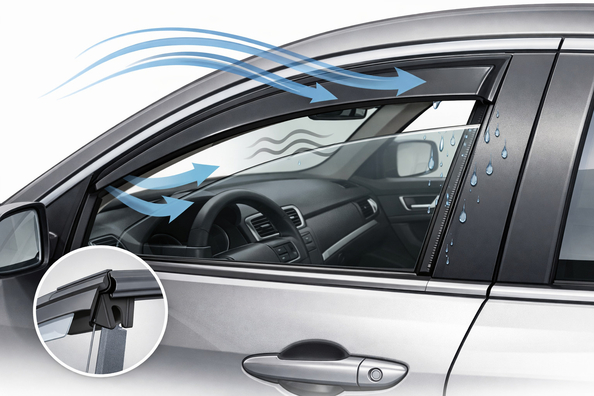
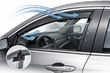
Noise, drafts, and raindrops with a slightly open window most often appear not because of “bad glass,” but because of aerodynamics around the window opening, the A-pillar, and the mirror housing. At speed, this produces either a dull, drum-like booming in the cabin or a whistle, and in rain the airflow can also pull water inside.
The key is not to confuse normal open-window buffeting with a real fault in the seal, the window channel, or a poorly fitted deflector. The solution depends on it: sometimes it’s enough to crack another window, sometimes a correctly chosen accessory helps, and sometimes spending money on a deflector simply doesn’t make sense.
When the glass is lowered even a few centimeters, the airflow from the roof, A-pillar, and mirror separates near the window opening and creates pressure pulsations in the cabin. That’s what causes the well-known “helicopter” effect that makes your ears pop. On many cars it shows up easily after 50 km/h, but the exact range depends on the body shape and which window is open.
Raindrops get into the cabin for the same reason. Water doesn’t just fall straight down: a vortex near the front corner of the door picks it up and drags it inside. That’s why on one car you can drive with a small gap with almost no discomfort, while on another even 1–2 cm immediately puts moisture on the door trim and the driver’s shoulder.
DD Tuning expert comment: The most common mistake is expecting complete silence on the highway with a cracked window. The second typical issue is installing an incompatible deflector into a dirty or cold window channel and immediately using the window lifter actively. As a result, people blame the accessory itself, even though the real cause is fitment, compatibility, or inflated expectations.
| Symptom | Likely cause | What to do |
|---|---|---|
| Dull, drum-like booming after 50 km/h | Classic buffeting from one open window | Crack another window slightly or change the opening height of the main one |
| Whistling in the upper front corner of the door | Turbulence near the mirror, A-pillar, or a gap by the deflector | Check deflector fit, the front edge, and the condition of the seal |
| Droplets hit the driver with a small crack | The airflow pulls water from the roof and the front corner of the door | Reduce the gap or install a vehicle-specific deflector for driving in rain |
| Noise is present even with the glass fully closed | Seal, window channel, mirror, or A-pillar area | Look for an issue with glass alignment and sealing, not the ventilation mode |
| After installing a deflector, the window doesn’t close normally | Wrong compatibility, installation misalignment, or auto-close malfunction | Reinstall the accessory, verify compatibility, and if needed recalibrate the auto-close |
| The rear window is noisier than the front | Body geometry specifics on that model | Find a suitable position of another window; don’t expect a universal effect from any deflector |
If the task is simple—keep the glass cracked 1–3 cm in the rain—it makes sense to look at vehicle-specific window deflectors. If you haven’t decided on the type yet, you can start with the general category of deflectors. And if a whistle appeared after installation or it’s unclear whether the issue is the install, it’s useful to compare common mistakes with our material about deflectors whistling at speed.
Replacing parts is justified when there are signs of wear: noise with the window closed, leaking, a stiff or cracked outer seal, uneven movement of the glass in the channel. In that case, an accessory can make use more pleasant, but it won’t replace fixing the underlying fault. If the issue is only normal buffeting with one window open, first check the position of the other window and only then buy something extra.
| Solution | When it works | When it’s not worth spending money |
|---|---|---|
| Crack another window slightly | Classic buffeting with one open window | If the whistle or noise remains even with the window fully closed |
| Change the opening height of the main window | When the noise appears only in a specific position | When you need rain protection, not just less booming |
| A model-specific in-channel deflector | For slight ventilation in rain, snow, or cool weather | If you expect complete silence at 100–120 km/h or drive with the window wide open |
| Reinstall the deflector and pause after installation | When after installation the glass rubs the edge, the whistle got worse, or the glass won’t pull fully up | If the kit itself doesn’t match the car’s shape |
| Replace seals or service the window channel | When there is noise, leaking, or whistling with the window closed | If the problem shows up only as normal booming from an open window |
| Refine the mirror or body aerodynamics | In complex model-specific cases when the exact noise source is known | For the typical task of “slightly ventilate the cabin without droplets” |
From a customer’s experience: often a person comes with the request “I want to drive in the rain with a cracked window without water and without booming.” When checked, it turns out the booming almost disappears if you open another window by a few millimeters, and a correctly chosen deflector really helps against droplets. Satisfaction here isn’t absolute silence, but that the cabin stays dry and you can get fresh air without constantly turning on the A/C.
Noise, drafts, and droplets from a cracked window usually have an aerodynamic nature rather than one universal “failure.” First, distinguish buffeting from a sealing problem: check the speed at which the noise appears, change the window position, crack another window slightly, and separately determine whether there’s a whistle with the window closed. A deflector is useful when you need to ventilate the cabin in rain and reduce direct blow-in, but it’s not a magic fix for complete highway silence. The material is based on real selection experience, hands-on practice, and real use cases—so the best strategy is simple: diagnose first, spend second.
Shipping to EU
Wholesale and retail
Own warehouse
Опис продукту
Подарунки не надаються при оформленні покупки у кредит під 0,01% або при покупці частинами.