04.09.2026
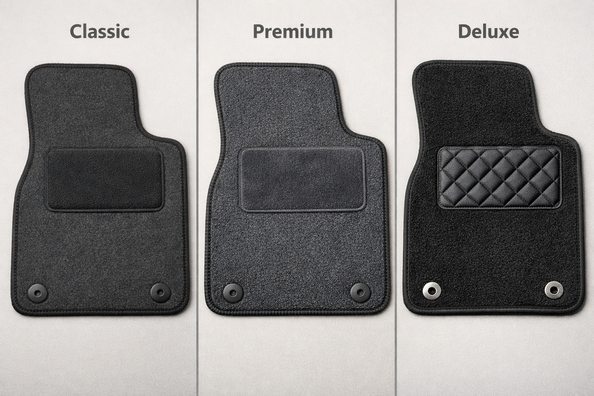
In short, the choice here isn’t between “bad” and “good,” but between three levels of comfort and durability. Classic makes sense when you need a neat set without extra spending; Premium usually offers the best balance of density, appearance, and wear resistance; Deluxe is chosen not for muddy practicality, but for the feel of a more upscale interior.
The main dividing line isn’t between these three series, but between textile itself and more utilitarian materials. If you have winter, slush, sand, wet shoes, and frequent trips out of town, any textile will lose to rubber or EVA in ease of care. That’s why pricier textile is worth choosing only when a softer cabin feel, a tidy look, and precise vehicle-specific fit truly matter to you.
The difference between Classic, Premium, and Deluxe is felt in three things: density, visual perception, and the reserve of durability under daily load. Classic is lighter and simpler, Premium is denser and holds its shape better, and Deluxe sits higher in terms of perceived finish. At the same time, all three options can be vehicle-specific, with mounts for factory locations, so basic geometry and safety depend not on the series name, but on whether the set is correctly selected for the car, year, and trim.
Another important point: more expensive textile does not turn into a winter “workhorse” mat. It can be nicer to the touch, denser, and tidier-looking, but textile still accumulates water and dirt. So the extra cost is justified when the car is mostly used in the city, you want the cabin to look neat every day, and not when the main task is to get through the wet season without drying.
Installation and fixation. The most important thing is that the mat fits into the factory locations, has the correct holes for mounts or clips, and doesn’t shift around the pedal area. This is especially critical for the driver’s mat. Thicker material isn’t better on its own if the shape isn’t precise.
Noise and underfoot feel. There are hardly any direct measurements specifically for these series, so here you look not at numbers but at real-world use. Denser textile usually feels quieter and softer than rigid materials, and the cabin looks less “utilitarian.”
Service life. For daily use, thickness, density, a heel pad in the driver’s area, and how well the mat keeps its shape after a few months of load matter. Classic has a decent service life for calm city driving, but it loses that “fresh, dense” feel faster. Premium holds its shape better, and Deluxe is often chosen also for its visual presentation.
Practicality. In the dry season, textile is convenient: it’s easy to vacuum, and the cabin looks tidy. In slush and snow, the downside is obvious: moisture stays inside the pile, and drying plus regular cleaning are needed. If you don’t do this, dampness and an unpleasant smell appear.
Price. This is where you decide whether moving up a level makes sense. In practice, Classic is the entry point, Premium is a noticeable extra cost for density and appearance, and Deluxe is another step up where you pay not only for durability, but also for the cabin’s perceived class.
| Option | Strengths | Weaknesses | Who it suits |
|---|---|---|---|
| Classic | Lowest price, light and flexible, sufficient for calm everyday driving, usually has basic fixation and heel-area protection | Lower density, loses the “fresh” feel faster under heavy use, less able to maintain a premium look | Those who want textile without a big overpay and drive mostly in the city |
| Premium | Denser, holds its shape better, looks more expensive, offers the best balance between price and perceived quality | Noticeably more expensive than Classic; in the dirty season it doesn’t become more practical than other textile series | Those who want a neat cabin every day and aren’t willing to overpay just for status |
| Deluxe | Strongest visual effect, more “status” perception of the cabin, appropriate for executive vehicles | Most expensive; the difference vs Premium isn’t always proportional to practical benefit; the series description may vary depending on the set | Those for whom the interior is part of their image and who consciously pay for premium feel |
DD Tuning expert comment: the most common mistake is looking only at the series name and not checking the shape for a specific trim. The second misstep is putting expensive textile into a winter daily routine and expecting rubber-like behavior. If in doubt, first check the mounts, pedal area, heel pad, and whether you’re really ready to dry the mats during the wet season.
This is the base level for those who want textile specifically, but without a big budget. A typical construction is about 5 mm with a multilayer backing, which makes the mat light, flexible, and trouble-free to install. For a city car, calm entry/exit, and normal care, this level is often enough.
The weak point of Classic isn’t that it’s “bad,” but its lower density. With intensive driving, frequent trips in heavy footwear, or constant load in the driver’s area, it loses the feel of a fresh set faster. If the car is used a lot and you want the cabin to stay “tight” for longer, this level may turn out too simple.
Premium is the most sensible choice in most scenarios. These mats are denser, in selection practice they hold their shape better, and visually they “pull together” the cabin more strongly. If Classic is simply tidy, Premium already gives the feel of a more cohesive and expensive interior without turning into a purely image-driven purchase.
The main advantage of Premium isn’t that it’s radically more practical than Classic in dirt, but that it holds its condition longer and feels nicer day to day. That’s why for a family car, a crossover, or a vehicle that’s heavily used in the city, it’s often the best compromise between price and durability.
Deluxe is the top level in the lineup, chosen primarily for how it presents the cabin. These sets typically emphasize a more expressive pile, a tidy look, and an overall feel of a more expensive interior. For cars where passengers, clients, or partners often see the cabin, this extra cost can be logical.
But it’s important not to overestimate the difference. Not every vehicle gets a practical gain from Deluxe over Premium that is noticeable enough to justify the price gap. Also, technical nuances of this series can vary depending on the specific set, so before buying it’s important to look not only at the name, but also at the backing, density, fixation method, and edge finishing quality.
For a calm city routine without constant mud, Classic is enough if the budget is tightly limited. For daily use, when you want both decent durability and a pleasant look, Premium most often wins. Deluxe is appropriate when the car doesn’t just transport you, but also creates an impression: a business sedan, a large crossover, a well-kept car for meetings or private transport.
If the car lives in a “winter, wet sneakers, kids, dog, trips to the country house” mode, the question should be framed differently: not which textile is better, but whether you need textile at all. In such conditions, even Deluxe doesn’t solve the main issue—moisture accumulation.
| Scenario | What’s best to choose | Why |
|---|---|---|
| City, calm driving, you just want a tidy cabin | Classic | You don’t overpay for excess density, you get a normal fit and basic comfort |
| Daily use, the car is used a lot, a neat look matters | Premium | Holds its shape better, looks more “put together” for longer, the price difference is usually justified |
| Executive interior, business car, the impression inside matters | Deluxe | Delivers the strongest visual effect and enhances the feeling of a more expensive interior |
| Autumn and winter, lots of wet dirt, snow, road chemicals | Don’t move higher within textile—reconsider the mat type itself | More expensive textile doesn’t remove the moisture issue; it only makes maintenance more costly |
| Long trips, heavy load on the driver’s area | Premium or Deluxe with proper fixation | Here density, heel pad, and precise fit matter—not just appearance |
Moving from Classic to Premium makes sense when you definitely want textile mats and are ready to pay extra for density, better shape, and a more cohesive cabin impression. Moving from Premium to Deluxe isn’t justified for everyone: it’s logical in a well-kept car where interior presentation matters, but not necessarily in a typical family-use routine.
If you’re looking at more expensive textile only because you want less hassle in autumn and winter, it’s better to first compare textile and rubber or even see what EVA and rubber solutions for daily use offer. In many cases, that’s more honest than overpaying for Deluxe if the main requirement is drier and easier to maintain.
From customer experience: a crossover driver initially wanted Deluxe so the cabin would look максимально tidy after detailing. After clarifying the conditions, it became clear the car is driven into the city every day, and in winter it often collects snow and water from shoes. In the end, he chose Premium for the warm season, because the difference vs Deluxe for his routine was less noticeable than the difference in price.
The selection scheme is simple: Classic—when you need textile without extra expense, Premium—when you want the healthiest balance of price, density, and appearance, Deluxe—when the cabin must make a more expensive impression and that truly matters to you. But in the wet season, textile at any level remains less practical than rubber or EVA, so paying extra only makes sense for a specific scenario, not “just in case.” This material is based on real selection experience, practice, and real-world use cases—not abstract promises from a catalog.
| ✔ | Classic offers basic textile without a big extra cost: lightweight, flexible, and sufficient for calm city driving. For those who value a neat cabin and a proper fit, this is a practical entry-level option. |
| ✔ | Premium looks like the most balanced option: it is denser than Classic, holds its shape better, and keeps the cabin looking tidy for longer. That is why it often makes sense for daily use. |
| ✔ | Deluxe delivers the strongest visual effect and the feel of a more expensive interior. This is appropriate if passengers often see the car or if the cabin is part of your image. |
| ✔ | All three series can be vehicle-specific with mounts for factory locations, so with the right set you can get a precise fit. This is important for safety, especially in the pedal area. |
| ✔ | Textile is convenient in the dry season: it is easy to vacuum, and the cabin looks neat. For city use without constant moisture, it is a perfectly workable solution. |
| ✘ | In slush, snow, and with wet shoes, any textile loses to rubber or EVA in ease of care. Moisture stays in the pile, so the mats need to be dried and cleaned regularly. |
| ✘ | Classic has lower density and loses the feeling of a fresh set faster under heavy use. For frequent trips or heavy footwear, it may turn out to be too simple. |
| ✘ | Deluxe is more expensive, but the practical gain compared with Premium does not always justify the price difference. If the main goal is not the impression but everyday usefulness, the extra cost may be barely noticeable. |
| ✘ | More expensive textile does not solve the moisture problem in winter. If the car is often driven in the dirty season, maintenance costs may turn out to be higher than expected. |
Shipping to EU
Wholesale and retail
Own warehouse
Опис продукту
Подарунки не надаються при оформленні покупки у кредит під 0,01% або при покупці частинами.