03.06.2026
325
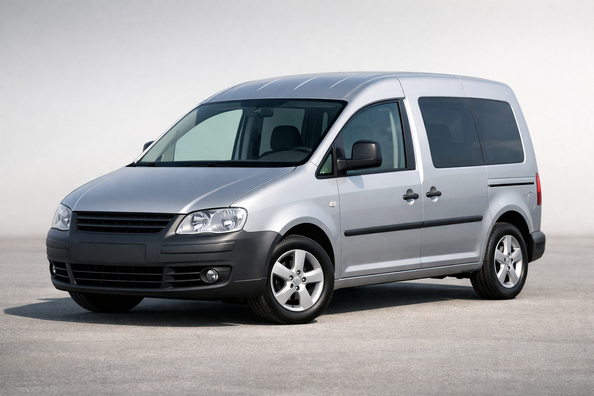
Volkswagen Caddy 2004-2010 is not just a compact van, but one of the most practical vehicles in its class for work, family trips, and mixed use. Its strength isn’t emotion, but the right body geometry, a large usable volume, simple cabin logic, and components shared with Volkswagen passenger models.
The key thing to understand before buying: Caddy III suits those who need capacity and durability without stepping up to the larger and more expensive Transporter. But it’s not a soft family minivan in the usual sense: when empty it rides on the firm side, sound insulation is modest, and weaker engines quickly show their limits under load.
The third-generation Caddy took an in-between position between a passenger wagon and a full commercial van. For small business it offers lots of usable space while keeping city-friendly dimensions, and for private owners it’s a way to carry strollers, bikes, tools, or gear without constantly playing “Tetris” in the trunk.
On the market, this model competed with the Ford Transit Connect, Citroen Berlingo, Peugeot Partner, Renault Kangoo, Fiat Doblo, and Opel Combo. Caddy’s strong point is a more car-like feel behind the wheel and a solid base for servicing and accessories. Its weak point is not the best comfort when empty and a more basic interior than regular passenger models.
The Caddy III generation appeared in 2003-2004 and became far more civil than its predecessor. The model is built on a platform related to the Golf V and Touran, so the handling and driving position feel closer to a passenger car than older utilitarian vans.
For the 2004-2010 topic, it’s important not to mix the pre-facelift vehicle with the 2010 update. The facelift is a separate 2010-2015 version with a different diesel lineup and a wider power range. Within this generation, two milestones also matter: in 2007 the Caddy Maxi appeared, 470 mm longer, and from 2008 all-wheel drive 4MOTION became available for some versions.
On the used market you most often see simple gasoline engines, the naturally aspirated 2.0 SDI diesel, and the most in-demand 1.9 TDI. Engine choice has the biggest impact on the Caddy experience: the body is practical, but a weak engine makes it sluggish on the highway and under load.
| Engine | Displacement and power | Gearbox | Practical takeaway |
|---|---|---|---|
| 1.4 16V | 1.4 L, 75 hp | 5-speed manual | Fine for city use without heavy loads, but there isn’t much pulling reserve. |
| 1.6 gasoline | 1.6 L, 102 hp | 5-speed manual | A calm option for passenger use, without strong low-end pull. |
| 2.0 SDI | 2.0 L, 70 hp | 5-speed manual | Simple, but very slow under load and on the highway. |
| 1.9 TDI | 1.9 L, 105 hp | 5-speed manual or 6-speed DSG | The most versatile engine for this generation in terms of pull-to-consumption balance. |
| 2.0 EcoFuel | 2.0 L, 109 hp | depending on version | A niche choice for those deliberately looking for the gas version. |
The base layout for most vehicles is front-wheel drive. DSG is not found on all versions, and when choosing a used car it’s worth considering only with a transparent service history. If you need a Caddy specifically “for work,” the healthiest compromise within 2004-2010 is a 1.9 TDI with a manual gearbox.
The Caddy was produced as a compact commercial van and as a passenger minivan, so the numbers depend on the configuration. That’s why listings often mix up capacity, weight, and ground clearance. The standard body is already very practical, and the Maxi wins significantly where cargo-bay length or a third row of seats matters.
| Parameter | Value |
|---|---|
| Production period | 2003/2004-2010, then a separate facelift 2010-2015 |
| Body | minivan or compact van, 4-5 doors, 5-7 seats depending on version |
| Length | 4405-4406 mm |
| Width | 1794-1802 mm |
| Height | 1823-1833 mm |
| Wheelbase | 2681-2682 mm |
| Ground clearance | about 154-176 mm depending on version |
| Trunk | 190-3020 L in passenger and converted configurations |
| Cargo bay | length 1781 mm, in Maxi — 2250 mm; width 1552 mm, between wheel arches 1172 mm |
| Cargo volume | 3.2-4.2 m³ |
| Suspension | front McPherson, rear leaf-spring layout; an empty vehicle can be firm |
| Towing | up to 1500 kg with brakes |
In terms of suspension, the Caddy is interesting because the front end behaves almost like a car, but the rear immediately reminds you of its commercial roots. An empty vehicle can feel rough over bumps, but under load it becomes more settled. In the city, large mirrors, an upright driving position, and a turning circle of about 11.1 m help.
The Caddy’s interior is functional rather than entertaining. Seating is high, visibility is good, there’s plenty of headroom, door openings are large, and the sliding doors are convenient in tight yards and parking lots. For a family this is a plus; for a work vehicle it’s an even bigger plus.
Comfort depends on expectations. The plastics are basic, sound insulation is weak, and at speed you can clearly hear tires, wind, and the rear body structure. On safety, the passenger Caddy Life scored 4 stars in a 2007 test: the body retained stiffness, but the driver’s chest protection wasn’t considered a strong point, and side curtain airbags were not standard across all trims. Separately, it’s worth carefully checking the condition and latching of the sliding doors.
In daily life, the Caddy wins not with brochure numbers but with the logic of use. It’s easy to load boxes, tools, bikes, or children’s items; the roof can carry up to 100 kg; and the 60 L fuel tank is enough for a normal work cycle without constant fuel stops.
Be realistic about fuel costs: official figures aren’t always achievable, especially in the city, in winter, with cargo, or with DSG. On older vehicles, typical issues include worn brakes, a tired exhaust, localized oil seepage, and suspension complaints. The upside is that many components are familiar to service shops and well known in the parts market.
This model suits couriers, installers, families with an active lifestyle, and anyone who wants to make a car into an all-round vehicle for every scenario. It’s not a great fit for those expecting a quiet cabin, a soft ride, and confident acceleration with any engine.
| Strengths | Weaknesses |
|---|---|
| Very roomy body for its exterior size | Rides on the firm side when empty |
| Convenient sliding doors and good visibility | Modest sound insulation, especially at speed |
| 1.9 TDI is well suited for mixed use | 2.0 SDI and weaker gasoline versions feel noticeably sluggish |
| More car-like driving manners compared to many competitors | Basic interior without a passenger-car comfort feel |
| A solid base for servicing and choosing accessories | On older cars, you need to pay close attention to brakes, exhaust, suspension, and door mechanisms |
From an owner’s perspective, the main advantage of the Caddy is versatility without moving up to a larger class. The main drawback is that it’s not about coziness, but about function. That’s exactly why people love it for usefulness and criticize it for noise and stiffness.
For the Caddy, tuning makes sense when it solves everyday tasks. On a work vehicle, the first justified upgrades are usually mats, protection for loading areas, roof cargo solutions, and small items that reduce interior wear. In the passenger version the logic is similar: practicality first, then decorative details.
If the Caddy often works with cargo, it’s also worth considering protection for the rear bumper and the sliding-door sills. But there’s no need to install everything at once: this model works best with a step-by-step selection based on a real usage scenario.
Volkswagen Caddy 2004-2010 is a strong option for those who need a compact but truly useful vehicle with a large reserve of practicality. The smartest choice in most cases is the 1.9 TDI with a manual transmission, while weak naturally aspirated engines are best only for a calm routine without постоянні loads. Before buying, it’s important to honestly assess the compromises: noise, stiffness, and age here are just as real as capacity and durability. This material is based on real selection experience, practice, and real usage scenarios, so the conclusion is simple: the Caddy is worth buying when you truly need its functionality, not just a big body.
| ✔ | Compact exterior dimensions are combined with a very spacious body and a large usable volume. This is convenient for work, hauling things, and family trips without moving up to a larger vehicle class. |
| ✔ | Sliding doors, a high seating position, and good visibility make the Caddy convenient in tight yards and parking lots. For everyday use, this really makes getting in, loading, and maneuvering easier. |
| ✔ | The 1.9 TDI is considered the most successful option for this generation in terms of balance between pulling power and fuel consumption. With a manual gearbox, it is the best suited for mixed use and work under load. |
| ✔ | The model has more car-like driving manners than many rivals in this class, because it is built on a platform related to the Golf V and Touran. This is noticeable in handling and seating position. |
| ✔ | The service base and parts selection for the model are generally familiar to the market, and there is also a decent range of accessories. This reduces the complexity of everyday maintenance and adapting it to your needs. |
| ✘ | An empty vehicle rides rather harshly, especially over bumps. The rear leaf-spring setup is a reminder of the model’s commercial roots. |
| ✘ | The sound insulation is modest, and at speed you can clearly hear the tires, wind, and body work. Because of this, the Caddy does not feel like a quiet family minivan. |
| ✘ | Weak engines, especially the 2.0 SDI and basic gasoline versions, feel noticeably sluggish under load and on the highway. For active driving or heavy work, their reserve of torque is too limited. |
| ✘ | On older vehicles, the brakes, exhaust, suspension, and sliding door mechanisms need to be checked carefully. The article directly mentions typical wear and local oil leaks. |
Shipping to EU
Wholesale and retail
Own warehouse
Опис продукту
Подарунки не надаються при оформленні покупки у кредит під 0,01% або при покупці частинами.