23.05.2026
337
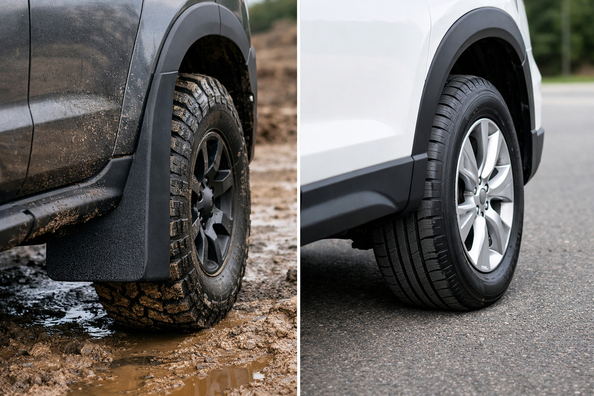
Wide mud flaps for an SUV make sense not on their own, but when the standard set no longer covers the real zone where dirt and stones are thrown. This happens on cars with wider tires, different wheel offset, a suspension lift, regular gravel driving, winter slush, or when towing a trailer.
For a stock city or highway crossover, overly wide and long mud flaps are often overkill: they’re harder to install, hang lower, catch curbs and snow more often, and don’t always deliver a noticeably better result. So what matters here isn’t maximum size, but the right balance of coverage, stiffness, mounting, and ground clearance.
The main question is simple: does dirt go beyond the factory trajectory that a regular vehicle-specific mud flap is designed for? If the wheel is in factory geometry, the tire isn’t wider than stock, and the car runs mostly on asphalt, a compact vehicle-specific set usually covers the basics without unnecessary compromises.
A wide option is justified when you need to cover at least the outer shoulder of the tire. If the mud flap is narrower than the actual tread or the wheel sits further out, some stones and slush will simply fly past the edge. But as soon as you add width and length, the requirements for mounting, road clearance, behavior in snow, and day-to-day usability increase immediately.
| Option | Strengths | Weaknesses | Who it’s for |
|---|---|---|---|
| Compact vehicle-specific | Easier to install, better preserves ground clearance, less likely to conflict with curbs and snow | May not cover a wider tire or a wheel with different offset; average protection on gravel | Stock crossover for city, highway, and moderate winter |
| Wide universal | Better covers the spray arc; you can choose greater width and length for non-standard wheels | Require fitting; catch more often; soft long versions can bend at speed | SUV with wider tires, a lift, gravel routes, or a trailer |
| Wide vehicle-specific or reinforced | More precise fit, more stable mounting, better behavior in winter and long-term use | Most expensive; not always friendly with non-stock wheels without checking clearances | For those who truly need wide protection but don’t want DIY fitting |
DD Tuning expert comment: The most common mistake is this: people see wide tires and immediately buy the longest possible kit without checking ground clearance and mounting points. As a result, the mud flap either hits curbs or gets bent by airflow. It’s smarter to first check whether it covers the outer shoulder of the tire and whether there’s rigid mounting at least at several points.
This is the basic choice for a factory configuration. If the wheels are stock and the body isn’t lifted, this set is usually enough because its geometry is designed for a specific wheel arch. The upside is simpler installation, a lower chance of catching curbs, and less unnecessary snow buildup around it in winter than with very long solutions.
The weak spot appears when the wheel becomes wider or sticks out more. In that situation the mud flap seems to be installed correctly, but in practice it only covers part of the trajectory, and dirt continues to hit the doors and rocker panels.
This is a choice for a task, not just an accessory. Typical wide solutions may be around 305–356 mm wide, and rear versions can be roughly 572–635 mm long, but this isn’t a universal standard across all product lines. This format is useful when you need to cover a wider wheel, an aggressive tread, or also protect a trailer from stones thrown from the rear.
The main trade-off for effectiveness here is installation and practicality. Marking, extra holes, and careful fitting are often required. Overtightening small fasteners is especially harmful: some instructions allow a very small torque, so you can’t tighten “all the way.” If the material is soft and long, airflow at highway speed can bend it; and if it’s mounted too low, it will start catching snow and curbs.
This is the most sensible upper segment for those who truly need a wide mud flap. The point isn’t just that it’s bigger, but the combination of accurate shape, proper thickness, multi-point mounting, and hardware that comfortably withstands moisture and salt. For stiffer, heavier solutions, thickness can be significantly greater than on thin polyurethane options, and this noticeably affects shape stability.
But even an expensive kit doesn’t eliminate the need to check compatibility. On vehicles with non-stock wheels, you need to check clearance at full steering lock, and in the rear the distance to the exhaust can sometimes be critical. After installation, it’s worth checking the fasteners periodically rather than considering the topic closed forever.
If an SUV lives in the city, drives on highways, parks near curbs, and doesn’t have wide wheels, a compact vehicle-specific kit usually wins on overall balance. It’s cheaper, quieter in everyday use, takes less ground clearance, and less often creates new problems for a questionable gain in protection.
If the car often sees gravel, salt, wet soil, and the tire is wider than stock or the wheel has a smaller offset, then a wide option no longer looks like overkill. Here it covers a real risk zone for the rocker panels, the lower edge of the doors, and the rear of the body.
For towing a trailer or harsh winter use, what works best is not the longest kit of any kind, but one that’s wide and securely mounted. Stability—not just size—determines whether a mud flap keeps its shape and effectiveness at speed and in the cold.
| Scenario | What to choose | Why |
|---|---|---|
| Stock crossover, city and highway | Compact vehicle-specific | Sufficient protection without losing practicality; easier installation and fewer chances to hit a curb |
| Tires wider than stock or different wheel offset | Wide universal or wide vehicle-specific | You need to cover the outer shoulder of the tire; otherwise dirt flies past the edge of the mud flap |
| Frequent gravel, salt, trips to the country or fields | Wide vehicle-specific or reinforced | Better balance of protection, service life, and mounting stability |
| Towing a trailer | Wide rear mud flaps | They help better shield the flow of stones and slush that goes toward the trailer |
| Deep snow, curbside parking, tight city driving | Not-too-long vehicle-specific or moderately wide | Lower and longer solutions catch more often and accumulate snow |
A more expensive kit is justified when you need not just a big piece of rubber, but a predictable result after installation. In that case, it makes sense to look not only at the general mud flaps catalog, but also pay attention to the shape for a specific arch, the number of mounting points, and hardware that holds up normally in salt and water.
If the vehicle already has non-stock wheels or you’re not yet sure about the geometry, sometimes it’s smarter to start by understanding the format via universal mud flaps. But paying more only makes sense when it delivers better fitment, stability at speed, and fewer chances you’ll have to rework it after the first winter.
For harsh winter use, gravel, and long service life, good results come not from a single accessory but from a protection package. So in some cases it’s also worth looking at inner fender liners if you need to better shield the arch from abrasive debris and moisture from the inside.
From a customer’s experience: On a mid-size SUV with wider winter tires, we initially wanted to install the longest universal mud flaps, because the main issue was slush on the doors and stones hitting the rocker panels on dirt roads. In the end we chose a wide but not too low kit with stable mounting. After that the body stayed cleaner, and there were no issues with curbs or car wash exits.
Wide mud flaps for an SUV are justified when the vehicle truly throws dirt and stones wider than a standard set can cover: wider tires, different offset, a lift, gravel, winter, a trailer. For a stock crossover without these factors, it’s often overkill, because the added protection doesn’t offset the loss in practicality.
The optimal choice here is almost never between “small” and “big,” but between sufficient and excessive. This material is based on real fitment experience, installation practice, and real-world use cases that clearly show: the best mud flap isn’t the biggest one, but the one that sits correctly and doesn’t get in the way of living with the car every day.
| ✔ | They are suitable in cases where the factory mud flap no longer covers the actual zone where dirt and stones are thrown up. This is relevant for wider tires, different wheel offset, suspension lift, gravel, winter slush, and trailer towing. |
| ✔ | Wide model-specific or reinforced versions provide a better fit and more secure mounting than universal long solutions. This is especially useful for winter use and long-term operation. |
| ✔ | With the right selection, they really do protect the sills, the lower edge of the doors, and the rear part of the body better. In other words, the effect is not just theoretical, but real on routes with mud, stones, and wet ground. |
| ✔ | For a trailer, wide rear mud flaps help block the flow of stones and slush more effectively. This makes them practical for towing, not just for appearance. |
| ✔ | In heavy winter and gravel scenarios, it is not only the size that matters, but also the rigidity of the mounting and the durability of the hardware. In a good design, a wide set can work reliably and not require quick rework. |
| ✘ | For a standard city or highway crossover, overly wide and long mud flaps are often overkill. They do not always provide noticeably better protection, but they do add new inconveniences. |
| ✘ | Such solutions are more difficult to install and often require marking, fitting, or even extra holes. This is especially true for universal options. |
| ✘ | Low and wide mud flaps are more likely to catch curbs, snow, and slush. In the city, this quickly turns into a constant source of problems. |
| ✘ | A soft or too long flap can bend under the airflow at speed. If the mounting is weak, even a large mud flap works worse than expected. |
Shipping to EU
Wholesale and retail
Own warehouse
Опис продукту
Подарунки не надаються при оформленні покупки у кредит під 0,01% або при покупці частинами.