11.06.2026
165
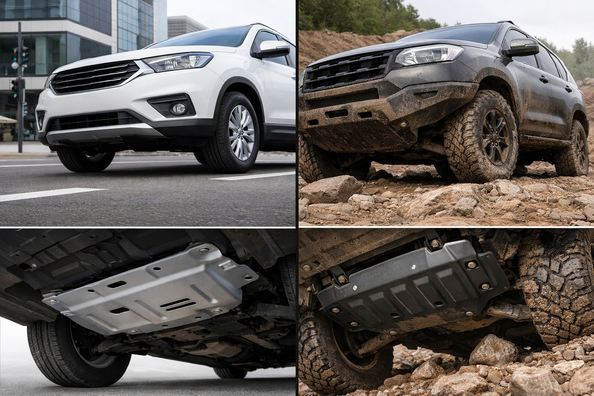
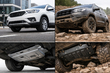
If a car spends most of its time in the city, on cleaned asphalt, and only rarely sees a dirt road, a thick metal guard is often unnecessary: a light splash shield is enough to keep dirt, water, and some noise out. But if your route includes broken roads, deep snow, ruts, rocks, or regular trips off asphalt, it’s time to look at aluminum or steel.
The confusion is that completely different products are sold under the same name — from a thin plastic undertray to a heavy-duty metal skid plate. That’s why the real choice starts not with the label, but with the material, thickness, mounting points, service access, and whether the part can take an impact, not just splashes.
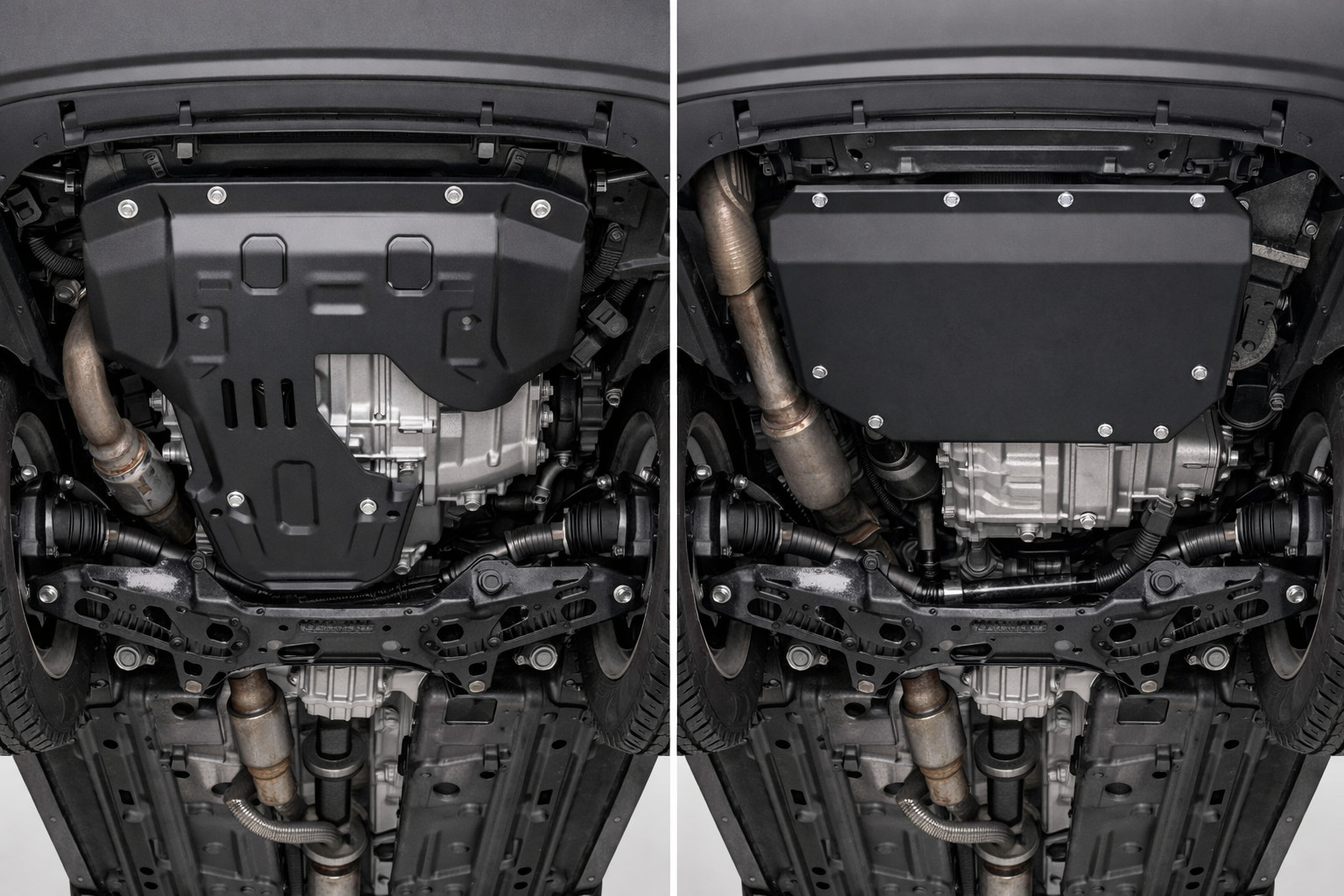
A city splash shield is mainly for water, dirt, small debris, and proper airflow under the car. It helps reduce noise, adds minimal weight, and works fine where the underbody barely meets obstacles.
A true engine sump guard is a part designed for impact loads. It has different stiffness, different weight, mounting matters more, and there are important service nuances: whether there’s access to the drain plug, whether you have to drill the body, and whether the plate conflicts with aero deflectors and nearby components.
Also check compatibility. Even a good kit may not fit due to a suspension lift, non-standard deflectors, or other underbody parts.
| Option | Strengths | Weaknesses | Who it’s for |
|---|---|---|---|
| City splash shield | Minimal weight, decent aerodynamics, protection from water and dirt, less chance of unnecessarily loading the car | Not designed for repeated heavy impacts, weaker on rocks and in ruts | Those who drive mostly in the city and on highways |
| Aluminum guard | Good balance of weight and stiffness, puts less load on the front end, often installs without drilling | Under hard contact it can dent, sometimes needs straightening | Those who drive in the city and on highways and regularly encounter bad roads, snow, dirt roads |
| Steel guard | Highest stiffness reserve, better tolerates frequent contact with rocks and sliding over obstacles | Heavier weight, corrosion risk, more dirt between the plate and underbody, higher maintenance demands | Those who truly drive off-road or work on rough routes |
DD Tuning expert comment: Most often people look only at metal thickness and don’t ask where exactly the guard mounts or whether there’s access to the drain plug. The second common mistake is installing a heavy steel plate on a car that sees only asphalt and curb edges in the yard. The result is extra weight, sometimes rattling due to mounting, and zero real benefit.
By weight, this is usually the lightest option: a reference can be parts within fractions of a kilogram, or plastic shields around 1.5–1.7 kg. This clearly shows their role: they’re not structural, but functional. Their job is to keep water, dirt, and small debris from flying into components from below and not to ruin aerodynamics.
For city use, this is often enough. But if the car bottoms out in a snowy rut, hits a sharp rock, or regularly drives over broken entrances, such a shield won’t always save you. The word “protection” can be misleading here: in practice it’s more of a screen than armor.
Aluminum is the healthiest compromise for mixed use. As a guideline, a 4 mm plate can weigh about 4.3 kg and mount at several points without drilling. This is no longer just an aero shield, but a part that takes hits from rocks, ice, uneven joints, and moderate off-road.
The main plus is lower weight compared to steel. The car doesn’t react as sharply to the added mass, and it’s easier to keep a balance between protection and everyday convenience. The main minus is that under hard contact aluminum can dent. That’s why it’s especially important that the plate fits tightly, doesn’t steal ground clearance, and doesn’t interfere with service.
Steel makes sense where impacts aren’t an exception but the operating mode. In larger kits, the weight difference is clearly noticeable: steel can be almost twice as heavy as aluminum. In return, it better tolerates repeated contact with terrain, sliding over rocks, and loads where a lighter material already starts to deform.
The downsides are just as straightforward: more weight, more attention to corrosion, and more washing after winter or mud. If salt, water, and sand accumulate between the guard and the body, durability drops not only for the plate but also for the fasteners. For a purely city car, this is often an excessive solution.
For the city, where the main risks are puddles, dust, small debris, and sometimes deep snow, a light OEM splash shield or a similar option usually covers the need. It doesn’t add noticeable weight and doesn’t complicate the car for no reason.
For a crossover or passenger car that doesn’t drive only on asphalt but often encounters broken driveways, dirt roads, and winter ruts, it’s more logical to consider aluminum. And if we’re talking about regular trips onto rocky routes, hunting, fishing, job sites, or serious off-road, steel provides the reserve you’re paying for.
For long-distance and commercial use, it’s not only the material that matters, but also serviceability. If you have to remove a heavy plate every time you change oil, or the guard blocks access to adjacent components, even a strong kit will quickly become annoying.
| Scenario | Best choice | Why |
|---|---|---|
| Daily city driving, parking, highway | City splash shield | Protects from water and debris without extra weight or added complexity |
| City plus bad yards, joints, potholes, deep snow | Aluminum guard | Handles accidental impacts better, but doesn’t weigh the car down like steel |
| Highway and regional roads with broken sections | Aluminum guard with proper bolt-on mounting | You need a balance of durability, noise, and service convenience |
| Fishing, hunting trips, field access roads, ruts | Steel guard or steel on the most vulnerable components | Here the stiffness reserve under repeated terrain contact matters |
| Work vehicle or regular heavy off-road | Steel kit with verified compatibility | The extra cost is justified where underbody hits happen constantly, not once a season |
A more expensive kit is justified when underbody impacts aren’t theoretical but regular: ruts, ice, rocks, descents to the water, construction sites, long trips on bad roads. In that case, it’s worth looking not only at engine guards, but also at adjacent components, because after the first contact it’s often not only the engine area that suffers.
If your route really touches the lower part of the car, also check the gearbox guard and don’t buy a kit blindly: service openings, mounting, and a fit that doesn’t reduce ground clearance matter. To realistically assess the line where metal is truly needed and where it only complicates the car, it’s useful to compare your logic with our material on when a guard really saves you and when it just adds extra weight.
From a customer’s experience: the owner of a city crossover initially wanted thick steel because he had scraped the underside a few times in a snowy rut. After reviewing the route, it turned out there was no real rocky off-road, but there were highways, yards, and rough driveways. In the end, he chose an aluminum option with proper bolt-on mounting and service access, and it was enough without extra load on the car.
The key difference is simple: a city splash shield works against water, dirt, and airflow issues, while a metal guard works against impact. For asphalt and urban conditions, a light OEM solution is usually enough; for mixed routes, aluminum is the smartest compromise; for regular harsh contact with terrain, you need steel. This conclusion is based on real-world selection experience, practical use, and real scenarios: look at your route, mounting, serviceability, and compatibility first — and only then at metal thickness.
| ✔ | A lightweight city shield is well suited for daily driving on asphalt: it protects against water, dirt, and small debris without unnecessary weight. For city use, it is more practical than installing a heavy plate “just in case.” |
| ✔ | An aluminum guard offers a good balance between weight and rigidity. It handles rough roads, snow, and dirt tracks better, while not weighing the car down as much as steel. |
| ✔ | A steel guard has the greatest rigidity reserve. It withstands repeated contact with stones, ruts, and sliding over obstacles better. |
| ✔ | Bolt-on mounting without drilling and proper fitment geometry reduce the risk of vibrations and service issues. This matters both for comfort and for future vehicle maintenance. |
| ✔ | The article clearly distinguishes which option suits a specific route. This helps avoid overpaying for excessive protection where a simpler solution is enough. |
| ✘ | A thin shield is not designed for repeated hard impacts, so on stones, in ruts, or on broken driveways its capabilities may not be enough. In such cases, the name “protection” is somewhat misleading. |
| ✘ | An aluminum version can dent under a hard impact. If the car often takes hits from below, sometimes you will have to accept dent repair. |
| ✘ | A steel guard is heavier and more demanding in maintenance: there is a risk of corrosion, and after winter or mud it needs more careful washing. Dirt, salt, and ice can also accumulate under the plate. |
| ✘ | Any poor installation or weak fasteners can cause rattling, misalignment, and problems during servicing. In other words, the material itself does not solve everything without proper installation. |
Shipping to EU
Wholesale and retail
Own warehouse
Опис продукту
Подарунки не надаються при оформленні покупки у кредит під 0,01% або при покупці частинами.