08.05.2026
759
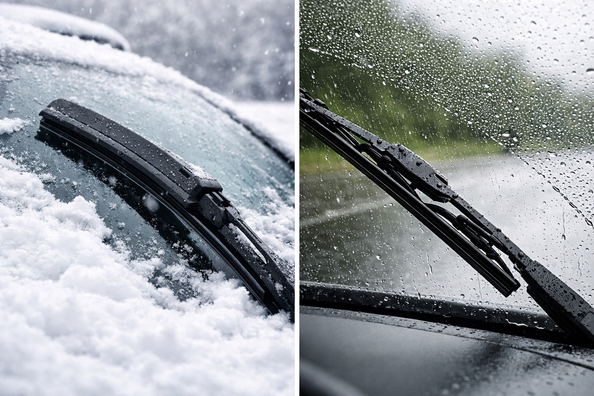
If your winter is just a few wet weeks and the occasional patch of ice, overpaying for winter wiper blades usually doesn’t pay off: more often, a quality all-season frameless or hybrid set is enough. But if your car spends nights outside, you often drive in snow, and the blade joints actually freeze up, a winter design delivers a tangible advantage—not in theory, but in everyday use.
The main mistake is choosing by what’s written on the box. More important than the marketing name are mount compatibility, exact length, behavior at speed, noise, service life, and whether you’ll have to swap one set for another twice a year.
A winter wiper isn’t for everyone. The point is that a mechanism covered by a sheath is less likely to get packed with snow and ice, so the blade stays flexible longer in freezing weather. This matters where wet snow is common, slush sticks to the windshield, and you head out in the morning from an open parking lot.
All-season frameless and hybrid models win in other ways: more stable pressure, better high-speed performance, less tendency to lift from airflow, and often quieter operation. That’s why for city driving, highways, and a mild winter, they’re often more practical than a separate winter set.
| Option | Strengths | Weaknesses | Who it suits |
|---|---|---|---|
| Winter | Handle snow and ice better, suffer less from frozen joints | More expensive, bulkier, not always the best at speed or in a mild climate | Drivers who often travel in snow and park outdoors |
| All-season frameless | Even pressure, better highway behavior, often quieter running | Cheap models can perform mediocrely; sometimes they fit worse at the edges of curved windshields | Most drivers in the city and on mixed routes |
| Hybrid | A compromise between frame stability and weather protection, often more consistent contact | Usually more expensive than basic solutions; still not universal for every windshield | Those who want one set for the whole year without extremes |
| Budget frame-type | Low price, easy replacement, sometimes decent results in the warm season | Freeze up faster, more often noisy, handle winter worse | As a temporary or strictly budget solution |
DD Tuning expert comment: most often, the people who make mistakes are those who buy the cheapest frameless blade thinking the design alone guarantees better performance. In practice, what matters is compatibility, rubber quality, and how the blade sits on your specific windshield. The second common misstep is buying a winter set for a mild winter but not checking the mount and the actual length.
Their strong point is protecting the mechanism from snow and ice buildup. When a regular frame freezes, pressure points work unevenly, and the blade starts smearing or chattering. In that scenario, a winter design really does provide better visibility.
The downside is that in a mild winter you’re paying for a feature you barely need. Also, a bulkier design won’t necessarily be quieter or better at high speeds.
This is the most sensible baseline choice for most people. A frameless blade holds its shape better in airflow, usually applies more even pressure along its length, and doesn’t require seasonal set changes. If you drive both in the city and on the highway, this is the most practical format.
But don’t confuse construction type with quality. A cheap frameless blade can be noisy, leave streaks, and lose to a regular frame-type blade if the rubber is weak or the profile doesn’t follow the windshield’s curvature well.
A hybrid is an attempt to combine the stability of a frame with better aerodynamics and partial protection from dirt and moisture. Often it’s a solid middle ground for those who want one set per year and don’t like experimenting.
Paying extra makes sense if you value predictable performance in rain, decent winter behavior without extreme icing, and fewer vibrations at speed.
You shouldn’t dismiss them automatically—but you should understand their limits. In warm weather and at lower speeds they can work acceptably, but in snow and ice they lose mobility sooner, and their service life and noise level are more often modest.
If the car sits outside, you leave early, and you regularly clear snow off the vehicle, winter blades often win simply because they don’t seize up from ice. This is the case where the extra cost is felt every day.
If winter is mostly wet, roads are cleared quickly, and your main trips are city and highway without snowdrifts, a quality all-season frameless or hybrid set gives a better balance. You don’t overpay for a separate seasonal kit and get more stable performance throughout the year.
For those who do a lot of highway driving in winter, the priority isn’t the word “winter” on the packaging, but pressure and stability at speed. That’s exactly where frameless and hybrid solutions are often more convincing.
| Scenario | Best choice | Why |
|---|---|---|
| City, moderate winter, car kept in a garage/parking | All-season frameless | One set per year is more practical, and the advantage of winter blades will be minimal |
| Open parking, frequent snow, early-morning departures | Winter | Less chance the mechanism will ice up and the blade will start smearing |
| Lots of highway driving in winter and autumn | Quality frameless or hybrid | Hold pressure better and work more calmly at speed |
| One vehicle for all seasons, no desire to swap sets | Hybrid | Offers a compromise between winter durability and everyday versatility |
| Tight budget | Correct-size frame-type or basic frameless | Better to get a compatible mid-level blade than an expensive set that fits poorly |
A pricier blade is justified not when you simply want to buy the more expensive option, but when it solves a specific problem. That could be regular freezing in an open parking lot, highway driving in rain and wet snow, increased sensitivity to noise, or the desire not to think about replacement too often.
If you need not the cheapest but a truly successful set, it’s logical to first check the wiper blade catalog, then separately compare details in the article about frameless wipers, and before buying, go through the selection by size and mount once more. This sequence usually saves more money than trying to buy the most expensive option right away.
From a customer’s experience: a crossover driver with overnight outdoor parking kept replacing inexpensive all-season blades almost every winter because they started smearing after a few freeze-ups. After switching to a winter set for the cold season, the missed spots in snow disappeared, and in spring he went back to a quieter frameless option for everyday city and highway driving.
For most drivers, overpaying for winter blades isn’t mandatory: a quality all-season frameless or hybrid set provides a better balance of price, quietness, stability, and year-round convenience. But if you regularly face snow, ice, open parking, and daily winter driving, a winter design pays for itself very quickly.
The key is not to look for a universal winner, but to choose blades for your scenario, your windshield, and your mounting type. This material is based on real selection experience, hands-on practice, and real usage scenarios—not on the simple logic of “more expensive means better.”
| ✔ | Winter wipers are genuinely useful where wipers regularly freeze up: the enclosed mechanism gets clogged less by snow and ice, so they work better in wet snow and in open parking lots. |
| ✔ | Quality all-season frameless or hybrid wipers are often more practical for city driving and highways: they maintain better pressure at speed, are usually quieter, and do not require seasonal replacement. |
| ✔ | Hybrid models offer a compromise between winter durability and everyday versatility, so they can be a convenient option for those who want one set for the year. |
| ✔ | The article emphasizes a practical approach to choosing: the exact length, the correct mount, noise, and service life matter more than what is written on the box. |
| ✘ | Paying extra for winter wipers in a mild winter often does not pay off if icing is rare and there are no regular snowy trips. |
| ✘ | Winter designs can be bulkier and do not always perform better at high speed or in a mild climate. |
| ✘ | Cheap frameless wipers do not guarantee good results: they can be noisy, streak, and fit the edges of curved glass worse. |
| ✘ | Budget frame-style models lose mobility in ice faster, are noisier more often, and handle winter less well. |
Shipping to EU
Wholesale and retail
Own warehouse
Опис продукту
Подарунки не надаються при оформленні покупки у кредит під 0,01% або при покупці частинами.