01.05.2026
280
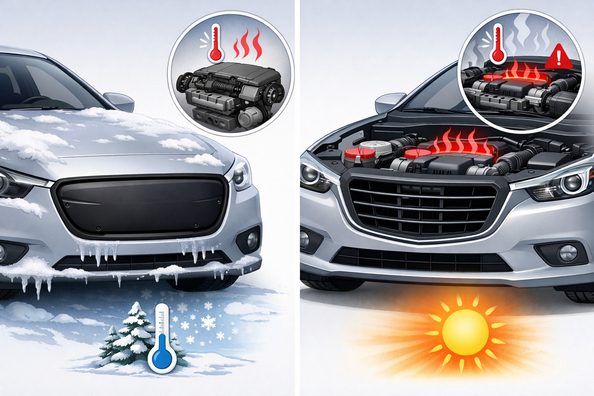
A winter radiator grille cover is not insulation “for the whole winter”, but a way to limit the flow of cold air when the engine would otherwise be overcooled. In hard мороз it helps the engine reach operating temperature faster, and the heater start blowing warm air sooner. But the same accessory during a thaw, on the highway, or with a trailer takes away the cooling system’s safety margin—and then it does harm. We break down where the line is, how to spot it by what the car is doing, and what the manufacturers themselves say.
Contents
Air doesn’t go through the grille only to the engine radiator. Up front there’s the A/C condenser, and on many cars there’s also a charge-air cooler (intercooler) and an automatic transmission cooler. The cover reduces airflow for all of them at once. While it’s freezing outside and the load is light, there’s more than enough reserve, and the engine simply gives off less heat to the oncoming air. As soon as it gets warmer or the engine works harder, that reserve disappears.
This is exactly how factory active grille shutters work: Valeo, which makes them, says that closed shutters in severe frost noticeably shorten warm-up time and the cabin heats up faster, and when cooling or A/C is needed, the electronics open the shutters. The difference is that shutters open by themselves, while the cover is removed by the driver. That’s why on cars with factory shutters an additional cover usually adds nothing.
There’s one condition for all cases: the cooling system must be in good working order. If the car won’t reach temperature even in a light minus, the weather isn’t to blame—it’s the thermostat, sensor, or coolant level, and the cover will only mask it.
There is no single temperature rule for all cars—each manufacturer calculates it for its own engine and radiator stack. That’s why the first source is your specific vehicle’s manual. As a guideline, here’s how official instructions phrase it:
The conclusion is simple: there are vehicles where the cover is предусмотрена, there are ones where it can be used with restrictions, and there are ones where the manufacturer is against it. Before buying, look in the winter operation section of your manual.
The most reliable check is to drive the same route in similar weather with the cover and without it. If without it the temperature returns to normal, you’ve found the cause. If not, look for a fault in the cooling system rather than swapping good parts at random.
A solid blanking cover удерживает heat best, but it also uses up the cooling reserve the fastest. A version with slots or sections warms a bit more slowly, but leaves a basic airflow—exactly what Ram requires. For daily driving that includes highway runs and changing weather, the second option is safer. Homemade cardboard is the worst choice: it gets wet, deforms, shifts, and blocks the grille with no расчет at all.
On most vehicles for which model-specific covers exist, air to the radiator comes through two zones: the upper grille between the headlights and the grille in the bumper under the license plate. That’s why covers are sold separately—this is essentially step-by-step adjustment. Start with the upper one: it blocks the main flow. Add the lower one when мороз is steady and the engine still takes a long time to warm up. When it gets warmer, remove the lower one first, and in stable above-freezing temperatures—remove both. A model-specific cover is not airtight; air passes through gaps, but the main reference point should always be engine temperature.
| Conditions | What to do with the cover |
|---|---|
| Steady frost, short city trips, engine takes a long time to warm up | Install the upper one; if not enough—add the lower one |
| Frost, long idling | You can leave it on; watch the temperature |
| Highway, long climbs | Open the lower zone or remove the cover completely |
| Trailer, fully loaded van | Remove it, especially near 0 °C and above |
| Thaw, мокрый snow, above freezing | Remove it |
| Traffic jams in warm weather, A/C on | Remove it |
| The fan switches on more often, temperature is higher than usual | Remove it and check the car without the cover |
| Without the cover the engine still won’t reach temperature | Diagnose the thermostat and cooling system |
| Snow, ice, dirt have packed under the cover | Clean the cover and the grille |
Two more practical points. Install the cover for the first time in a warm помещение: plastic is stiff in the cold, and the fasteners seat worse. And during the season, remove it from time to time to clean out salt and ice—buildup reduces the real airflow more than it seems.
The cover must fit the grille of the specific body and year exactly—otherwise it blocks the wrong zones or doesn’t hold well. A general overview of ways to cover the grille is in the article what to cover a car’s radiator grille with, and all model-specific options are in the section winter grille covers. We’ve also broken it down by models отдельно:
An example of separate covers: for Volkswagen T5 2003–2010 there is an upper grille cover and a full lower one; for Renault Master—an upper one for 2010–2014 and a lower one for 2011–2019. If you’re unsure about the body or year, send the manager a photo of the front end—we’ll подобрать an option.
We ship via Nova Poshta throughout Ukraine; orders from 15 000 ₴ are delivered free of charge by our own транспорт.
| ✔ | The engine reaches operating temperature faster in steady frost |
| ✔ | The heater starts blowing warm air sooner, especially on short trips |
| ✔ | The model-specific cover can be installed in sections: the upper and lower parts separately |
| ✔ | At idle in frost, the engine cools down less |
| ✘ | During thaw, on the highway, with a trailer, and in warm traffic jams, the risk of overheating increases |
| ✘ | It also restricts airflow to the air conditioner, intercooler, and transmission radiator |
| ✘ | Requires attention: remove it when it gets warmer and clean off snow and ice |
| ✘ | On some cars, the manufacturer does not allow covering the radiator, and with factory shutters it is not needed |
Shipping to EU
Wholesale and retail
Own warehouse
Опис продукту
Подарунки не надаються при оформленні покупки у кредит під 0,01% або при покупці частинами.