22.08.2026
106
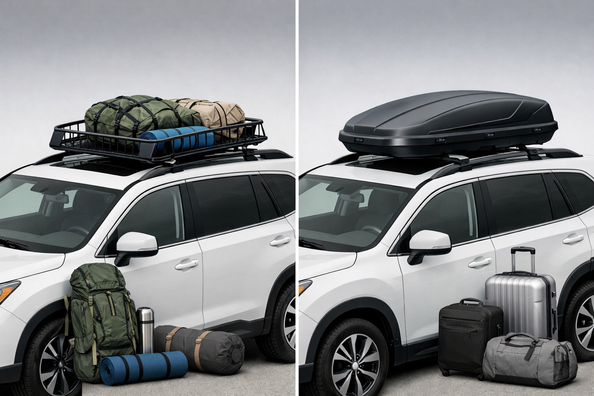
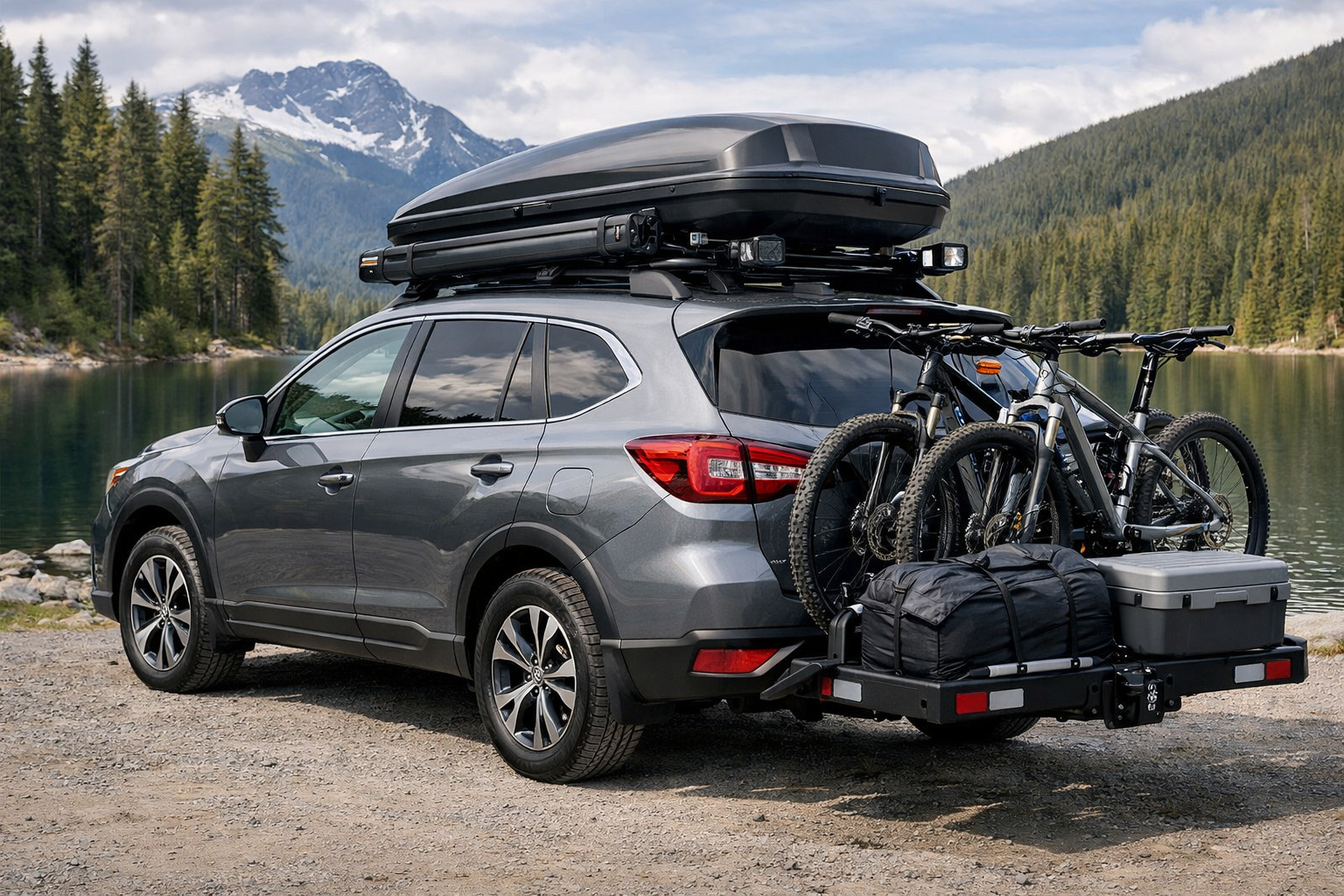
If you need an affordable base for different kinds of gear, it makes more sense to start with crossbars for roof rails. If the goal is to carry suitcases, kids’ items, skis, or soft luggage dry and locked, it’s more practical to look toward a roof box. An important nuance: this isn’t strictly an “either-or” choice, because a roof box is mounted specifically on crossbars.
So the real question is: is a roof base enough for you, or do you need enclosed cargo volume. The difference between these solutions is felt not only in price, but also in road noise at highway speeds, vehicle height, fuel consumption, ease of installation, and how often you’ll actually use all of it.
Crossbars for roof rails are a universal platform. You can mount bike racks, ski carriers, kayak/canoe mounts, a basket, or that same roof box on them. By themselves, they don’t solve protection from rain, dust, and theft, but they provide the most flexible starting point.
A roof box is a ready-made enclosed volume on the roof. It’s more convenient specifically for trips, when you need to get suitcases, a stroller, winter clothing, or gear out of the cabin. But along with that come a higher price, additional vehicle height, speed limitations, compatibility requirements, and more noticeable hassle with off-season storage.
Separately, you need to look at the car’s permitted roof load. It’s not only the weight of the cargo that counts, but the sum of the crossbars, the box itself, and the items inside.
| Option | Strengths | Weaknesses | Who it’s for |
|---|---|---|---|
| Crossbars for roof rails | Lower price, versatility, can be used with different attachments, easier to remove for the off-season | No enclosed volume, open cargo must be secured, possible noise and increased fuel consumption | Those who carry different gear, don’t want to overpay, and don’t need suitcase space every week |
| Roof box | Enclosed volume, protection from rain and dirt, more convenient for suitcases, skis, and family trips | More expensive, adds height, changes vehicle behavior at speed, requires a compatible base | Those who travel regularly, go on vacations, or often run out of space in the stock trunk |
DD Tuning expert comment: The most common mistake is choosing a box only by liters without checking roof length, clearance to the tailgate, and permitted load. The second typical issue is buying the cheapest crossbars and then being surprised by highway noise or play with a heavy box. For travel, not only capacity matters, but the compatibility of the whole system.
This is the smartest start when the budget is limited or the scenarios vary: skis today, a bike tomorrow, then long cargo. Price-wise, basic rectangular crossbars can be several times cheaper than a quality box, while aerodynamic models are noticeably more expensive—but quieter and nicer for everyday driving.
The main downside is that crossbars alone don’t solve travel luggage. You can’t just put suitcases on them. In addition, even without cargo they can be noisy and affect fuel consumption; at highway speeds, removing the crossbars can sometimes make a very noticeable difference in efficiency.
In terms of durability, it’s a simpler system: less plastic, hinges, and locks. But a lot depends on the quality of the mounts, correct tightening, and whether they’re left on the roof year-round.
For travel, a roof box is more practical because it provides an enclosed, clean space. In medium and large sizes, it’s real volume for suitcases, skis, clothing, and kids’ items. This is exactly where it beats a simple base: you don’t have to pack things separately to protect them from rain, and you don’t have to think every time about how to strap them down.
But a box isn’t only extra volume. It adds height to the vehicle—sometimes very noticeably—so underground parking, gates, and car washes immediately become a concern. Manufacturers also explicitly limit driving speed with a box, and in crosswinds, corners, and braking the car feels different.
Another nuance is installation and compatibility. The box itself can weigh around 20 kg, meaning it’s not always convenient to mount it alone. Add to that requirements for the distance between crossbars, the clamp width of the mounts, and clearance to the tailgate. If these parameters aren’t checked in advance, an expensive box can turn out to be inconvenient on your specific car.
For occasional trips outdoors, transporting sports gear, or work items, it’s more logical to choose crossbars. You pay less, don’t carry extra volume every day, and can buy attachments for a specific task.
For family trips for a few days or longer, a roof box is noticeably more convenient. It frees up the cabin, helps you avoid stacking things to the ceiling, and is better for soft luggage that doesn’t like dirt and moisture.
If the car is used daily in the city and regularly goes into low parking garages, a tall box can get annoying faster than it will delight. In that scenario, either you stick with crossbars only, or choose a low-profile box and use it seasonally.
If the trips are long and frequent, the choice often comes down not to “crossbars or box,” but to “which crossbars plus which box.” A cheap base for a heavy box is false economy.
| Scenario | What’s better to choose | Why |
|---|---|---|
| One-off vacation trips 1–2 times a year | Crossbars if there aren’t many things; a box if the cabin is already tight | No point overpaying for a box if you truly need it very rarely |
| Family with kids, stroller, suitcases | Roof box | Provides enclosed volume and frees up cabin space where it’s felt most |
| Skis, snowboard, winter clothes | Roof box | Gear is protected from snow, moisture, and road grime |
| Bikes, ladders, pipes, long cargo | Crossbars | For open and long loads, a base is more practical than an enclosed box |
| Daily city car with parking garages | Crossbars or a seasonal low-profile box | Height and noise become more important than capacity itself |
More expensive aerodynamic crossbars make sense if you often drive on the highway and don’t want to put up with whistling. The comfort difference here can sometimes matter more than the price difference itself, especially on tall crossovers and wagons. If you’re unsure about the base, it’s worth first understanding what kinds of roof racks there are.
A more expensive roof box is justified when trips are regular, not one-off: vacations, winter getaways, long routes with a full cabin. In that case, not only liters matter, but also quick mounting, reasonable aerodynamics, reliable lock operation, and compatibility with your base. Before buying, it’s useful to check which crossbars can actually handle a roof box.
Another case where the extra cost is justified is sensitivity to noise. On one car, the difference between a basic and a well-designed system will be small, while on another it will determine whether you’ll want to take everything off after the first trip. If that’s your main worry, read separately why a roof box makes noise on the highway.
From a customer’s experience: a common scenario is a family crossover that fits everything day to day, but before vacation the cabin gets packed with suitcases and kids’ items. In that case, people often start with crossbars and then move to a medium or low-profile box, because it’s the box that removes the chaos from the cabin. The biggest satisfaction isn’t the volume itself, but the fact that things travel separately, cleanly, and without stacking up to the windows.
In short, crossbars for roof rails are about versatility, a lower entry budget, and different types of cargo. A roof box is about enclosed volume, a tidy cabin, and comfort on trips, but with a higher price, greater vehicle height, and stricter compatibility requirements.
So for occasional tasks and varied gear, it makes more sense to get a crossbar base, while for regular trips with suitcases, skis, or kids’ items, plan on a box right away. This material is based on real selection experience, practice, and real usage scenarios: they best show that a base is needed for flexibility, and a roof box is for consistently comfortable trips.
| ✔ | Roof crossbars provide a universal base: you can mount bike, ski, boat, or cargo box carriers on them. This is convenient if your transport needs change often and you don’t want to buy a separate solution for each case. |
| ✔ | Crossbars usually cost significantly less than a cargo box, so they’re a logical starting point for a limited budget. In addition, basic models are easier to remove, and you don’t need to carry extra bulk when the trunk is not in use. |
| ✔ | A cargo box provides a closed loading space that protects items from rain, dust, and dirt. For suitcases, children’s items, skis, and soft luggage, it’s more practical than an open base. |
| ✔ | A cargo box helps free up the cabin during family trips. When there are many things in the car, it lets you avoid stacking everything to the ceiling and makes luggage placement more organized. |
| ✔ | For regular longer trips, a box is often more convenient for everyday use, because there’s no need to secure open cargo separately with straps. This saves time before departure and reduces the risk of items shifting on the road. |
| ✘ | Crossbars alone do not solve the problem of closed cargo capacity. You can’t place suitcases or soft items on them without additional solutions, and open cargo must be secured separately. |
| ✘ | Both crossbars and a cargo box can create noise on the highway and also increase fuel consumption. For high-speed trips, this is already a noticeable drawback, not just a minor inconvenience. |
| ✘ | A cargo box is more expensive and more complicated to choose: you need a compatible base, the correct distance between the crossbars, and to check the clearance to the trunk lid. If you don’t do this, even an expensive box may not fit a particular car. |
| ✘ | The box adds height to the vehicle, so it can cause problems with low parking garages, gates, and car washes. Manufacturers also limit the driving speed with a box, and on the highway the car behaves differently. |
| ✘ | The box itself and its mounts are more sensitive to overloading, impacts, and improper storage. Off-season, it also adds the hassle of storage, because it’s a bulky item. |
Shipping to EU
Wholesale and retail
Own warehouse
Опис продукту
Подарунки не надаються при оформленні покупки у кредит під 0,01% або при покупці частинами.